Acoustics
How does the decibel scale work?
Short answer
Decibels are a logarithmic scale. Two equally loud sources together give +3 dB, and +10 dB sounds about twice as loud.
Explanation
Sound is a pressure wave. The decibel scale expresses its strength logarithmically. A-weighting (dB(A)) takes into account how the ear hears different pitches. The human ear hears roughly from 20 to 20 000 Hz.
Rules of thumb
- Two equal sources: +3 dB. [SW-S11]
- +10 dB: sounds about twice as loud. [SW-S11]
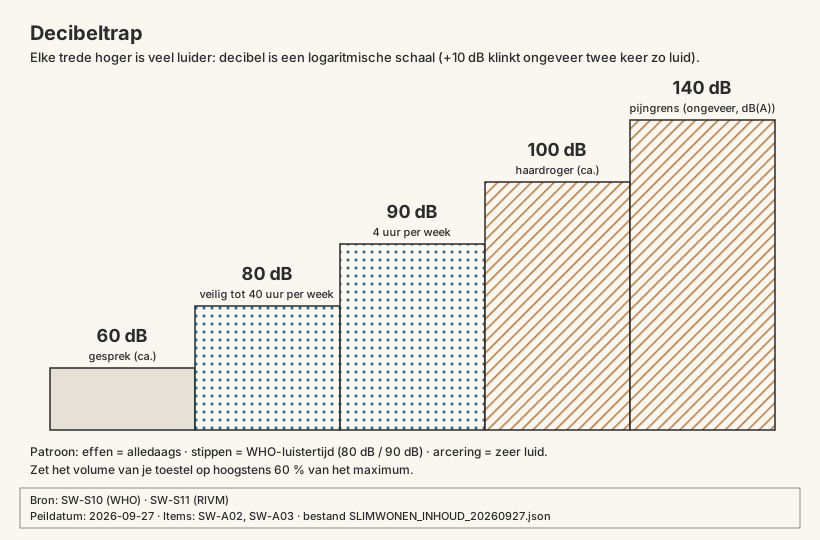
- Examples according to WHO: conversation about 60 dB, hair dryer about 100 dB. [SW-S10]
- Pain threshold: about 140 dB(A). [SW-S11]
Pitfalls
- You cannot simply add decibels: 60 dB + 60 dB is 63 dB, not 120 dB. [SW-S11]
Search terms
These search terms are in Dutch; only terms that also find a topic in English are links.
Read also
General information, not personal advice. Check the source and reference date.
Sources
- SW-S10 Deafness and hearing loss: Safe listening (Q&A) — WHO (Reference date 2026-09-27)
- SW-S11 Grondbeginselen van geluid (GGD-richtlijn medische milieukunde omgevingsgeluid) — RIVM (Reference date 2026-09-27)
Reference date: 2026-09-27 · Translated with AI from the Dutch original.