Energy
How does the capacity tariff in Flanders work?
Short answer
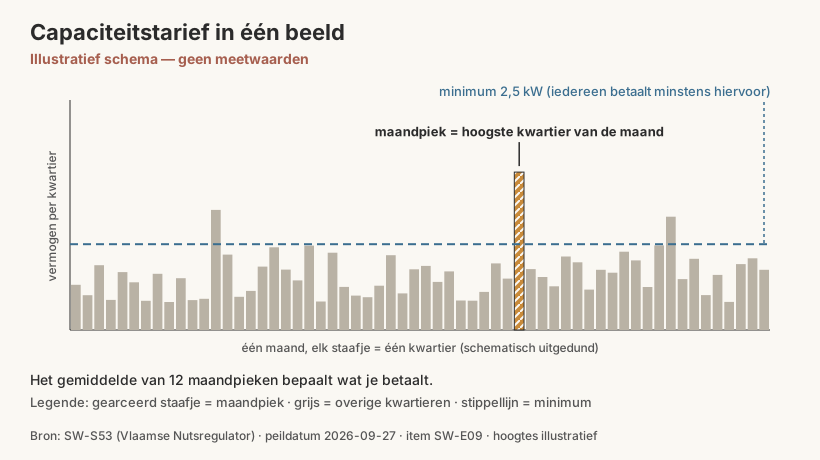
Part of the grid charges depends on your highest quarter-hour consumption per month. Everyone pays for at least 2.5 kW.
Explanation
The digital meter measures per quarter hour. The highest quarter of the month is your monthly peak. The average of 12 monthly peaks determines what you pay. The average Flemish household has a monthly peak of about 4.24 kW.
Rules of thumb
- Minimum: 2.5 kW. [SW-S53]
- 2026: about € 53.39 per kW per year (varies by grid operator). [SW-S53]
- Spread heavy appliances (heat pump, tumble dryer, dishwasher, charger) over different quarter hours. [SW-S53]
Pitfalls
- With a conventional meter you pay a fixed contribution equal to the minimum; with a digital meter it depends on your peaks. [SW-S53]
By region
- Flanders
- Flemish Utility Regulator. [SW-S53]
- Netherlands Wallonia Brussels
- Other grid tariff structures; not covered. [SW-S53]
Search terms
These search terms are in Dutch; only terms that also find a topic in English are links.
capaciteitstarief piekvermogen kW digitale meter Fluvius
Read also
- Is a dynamic energy contract with smart control worth it?
- What can I do with the P1 port of my digital meter?
- How do I get more out of my solar panels?
General information, not personal advice. Check the source and reference date.
Sources
- SW-S53 Capaciteitstarief — Vlaamse Nutsregulator (VREG) (Reference date 2026-09-27)
Reference date: 2026-09-27 · Translated with AI from the Dutch original.