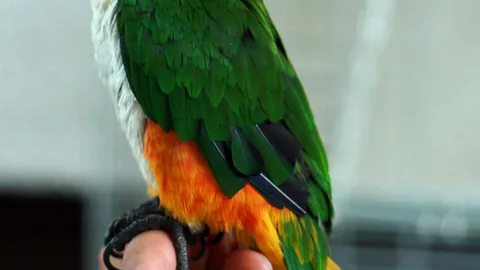
Black-headed Caique as a pet
Pionites melanocephalus
In short
This species may suit you if you can care for the bird for up to about 40 years [S52, S64]. Biggest trade-off: much is still unknown in the sources (noise class, space class, suitability for beginners and annual cost). The perfect parrot doesn’t exist: a species profile is no guarantee about your bird.
This information was compiled with AI from public sources and may contain errors. Always check legal rules with the competent authority. Not buying, veterinary or legal advice.
Talking
Rarely mimics speech well; mostly everyday sounds (alarm clock, smoke detector, microwave) [S52].
Noise
WPT: ‘notably vocal and gregarious’ [S64]. That is about how often they call, not how loud; loudness remains unknown.
Lifespan
25–40 years in captivity according to World Parrot Trust [S64]; Wikipedia gives no figure [S52].
Space
WPT: aviary or suspended cage at least 2 m long [S64]; secondary source: cage at least 61 × 61 × 91 cm [S52]. No area per pair, so space class unknown.
Suitable for beginners?
Tends to bite; teach boundaries early [S52]. World Parrot Trust (S64) checked on 20/9/2026 for an explicit statement about beginners: none found.
Costs
No comparable source for annual costs found.
Paperwork and rules in Belgium
EU Annex B (CITES II). Ask the seller for proof of legal origin (invoice, transfer declaration; EU model recommended) and keep it [S40]. According to the FPS, anyone who buys, sells or breeds these birds keeps a register of arrivals and departures and keeps it for at least 5 years [S39]. Status as of 27 September 2026; check the current rules for your bird with the Belgian FPS Public Health [S39].
Adoption and availability
Not seen on the rescue pages we read.
What you have to accept
- Still unknown in the sources: noise class, space class, suitability for beginners and annual cost. That is not a ‘yes’.
- EU Annex B: ask the seller for proof of legal origin and keep it [S40].
- Adoption: not seen on the rescue pages we read; availability changes.
Compare with
Senegal Parrot: a similar profile on the known criteria, but longer commitment (‘even longer than 40 years’) [S48, S52, S64, S66].
Senegal Parrot · Compare with Senegal ParrotGreen-cheeked Parakeet: seen at a rescue [S71].
Green-cheeked Parakeet · Compare with Green-cheeked ParakeetPacific Parrotlet: a similar profile on the known criteria.
Pacific Parrotlet · Compare with Pacific Parrotlet
Source basis
Conservation organisation (WPT) + secondary source
Guideline sizes, costs and adoption listings come from Flemish sources; different rules may apply in Brussels and Wallonia. Foreign housing rules are not Belgian rules.
Sources
- S39 · FOD Volksgezondheid — CITES-regels: Papegaaien · read 2026-09-24
- S40 · FOD Volksgezondheid — Beschermde soorten bezitten · read 2026-09-19
- S48 · VCA — Senegal Parrots: General · read 2026-09-19
- S52 · Wikipedia — Black-headed parrot · read 2026-09-19
- S64 · World Parrot Trust — Parrot Encyclopedia: Black-headed Parrot · read 2026-09-19
- S66 · World Parrot Trust — Parrot Encyclopedia: Senegal Parrot · read 2026-09-19
- S71 · adopteereendier.be — Volièrevogels · read 2026-09-19
Sources checked as of:
Frequently asked questions
Which papers do you need for the Black-headed Caique in Belgium?
EU Annex B (CITES II). Ask the seller for proof of legal origin (invoice, transfer declaration; EU model recommended) and keep it. According to the FPS, anyone who buys, sells or breeds these birds keeps a register of arrivals and departures and keeps it for at least 5 years. Status as of 27 September 2026; check the current rules for your bird with the Belgian FPS Public Health.
How long does the Black-headed Caique live?
25–40 years in captivity according to World Parrot Trust; Wikipedia gives no figure.
How loud is the Black-headed Caique?
WPT: ‘notably vocal and gregarious’. That is about how often they call, not how loud; loudness remains unknown.
Can the Black-headed Caique learn to talk?
Rarely mimics speech well; mostly everyday sounds (alarm clock, smoke detector, microwave).
How much space does the Black-headed Caique need?
WPT: aviary or suspended cage at least 2 m long; secondary source: cage at least 61 × 61 × 91 cm. No area per pair, so space class unknown.
What does the Black-headed Caique cost per year?
No comparable source for annual costs found.