Grey Parrot as a pet
Psittacus erithacus
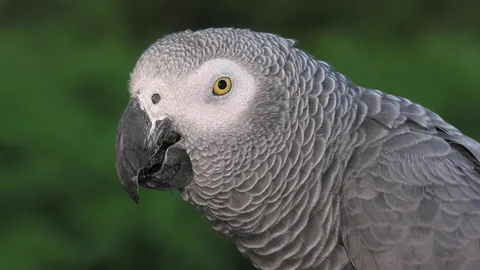
In short
This species may suit you if you can live with noise level ‘loud’, have room for an enclosure in class ‘large’ and can care for the bird for even longer than 40 years [S5, S21, S37]. Biggest trade-off: the EU Annex A paperwork, with a certificate and ring for each bird [S39, S40, S77]. The perfect parrot doesn’t exist: a species profile is no guarantee about your bird.
This information was compiled with AI from public sources and may contain errors. Always check legal rules with the competent authority. Not buying, veterinary or legal advice.
Talking
Great ability to mimic; speech is never guaranteed. [S5, S12]
Noise
Whistling and screaming; can be noisy at sunrise/sunset. [S5]
Lifespan
Can reach about 60 years; many birds don’t. [S5, S37]
Space
Flanders: a pair at least 200 × 200 × 200 cm; one bird at least 120 × 80 × 100 cm plus hours of free flight every day [S37]. Swiss law (for comparison; does not apply in Belgium) 0.7 m² per pair [S21].
Suitable for beginners?
Flanders: ‘not a bird for beginners’ (translated from Dutch) [S37].
Costs
From €300 per year per bird. Huisdierwijzer, Flemish pet guide (grey parrot): €25–50 per month × 12 [S37]. Price level unknown; not a full budget or quote.
Paperwork and rules in Belgium
EU Annex A (CITES I). An original European CITES certificate (yellow A4) for each bird, with a matching ring number; check box 20 for restrictions [S39, S40]. Captive-born and captive-bred Annex A birds must also wear a closed, seamless leg ring with a unique mark, except species on the list of commonly bred species (that list was not checked here) [S77]. In exceptional cases (physical or behavioural traits of the bird) a microchip may replace the closed ring; if a vet removes a closed ring for medical reasons, the replacement chip number must be on the vet’s certificate [S77]. According to the FPS, anyone who buys, sells or breeds these birds keeps a register of arrivals and departures and keeps it for at least 5 years [S39]. Status as of 27 September 2026; check the current rules for your bird with the Belgian FPS Public Health [S39].
Adoption and availability
Grey parrots at Nally’s [S70]. The rescue requires an enclosure of at least 800,000 cm³ for this species [S69].
What you have to accept
- EU Annex A: an original EU certificate with a matching ring number for each bird, and as a rule a closed, seamless leg ring [S39, S40, S77].
- According to the sources, not a species for beginners [S37].
- Noise class ‘loud’: only choose this species if your home situation can handle it [S5].
- Lifespan: according to the sources this species can live longer than 40 years; plan who will care for it if your life changes [S5, S37].
Compare with
Orange-winged Amazon: less paperwork (EU Annex B versus EU Annex A) [S39, S40].
Orange-winged Amazon · Compare with Orange-winged AmazonEclectus Parrot: quieter according to the sources (‘quiet’ versus ‘loud’), less paperwork (EU Annex B versus EU Annex A) [S5, S39, S40, S62].
Eclectus Parrot · Compare with Eclectus ParrotSenegal Parrot: less paperwork (EU Annex B versus EU Annex A) [S39, S40].
Senegal Parrot · Compare with Senegal Parrot
Source basis
Species profile; Timneh treated separately
Guideline sizes, costs and adoption listings come from Flemish sources; different rules may apply in Brussels and Wallonia. Foreign housing rules are not Belgian rules.
Sources
- S5 · LICG — Grijze roodstaartpapegaai · read 2026-09-06
- S12 · Benedict e.a. (2022) — vocal mimicry survey · read 2026-09-06
- S21 · BLV — Papageien im Tierschutzrecht · read 2026-09-11
- S37 · Vlaanderen — Huisdierwijzer Grijze roodstaartpapegaai · read 2026-09-19
- S39 · FOD Volksgezondheid — CITES-regels: Papegaaien · read 2026-09-24
- S40 · FOD Volksgezondheid — Beschermde soorten bezitten · read 2026-09-19
- S62 · LafeberVet — Basic Information Sheet: Eclectus Parrot (C. Pollock, DVM, DABVP Avian, 8 januari 2012) · read 2026-09-19
- S69 · Nally's Papegaaienopvang vzw (Oedelem) — Adopteer een papegaai · read 2026-09-19
- S70 · adopteereendier.be (Vlaamse overheid) — asielpagina Nally's Papegaaien Opvang · read 2026-09-19
- S77 · FOD Volksgezondheid — Identificatie en markering (CITES) · read 2026-09-21
Sources checked as of:
Frequently asked questions
Which papers do you need for the Grey Parrot in Belgium?
EU Annex A (CITES I). An original European CITES certificate (yellow A4) for each bird, with a matching ring number; check box 20 for restrictions. Captive-born and captive-bred Annex A birds must also wear a closed, seamless leg ring with a unique mark, except species on the list of commonly bred species (that list was not checked here). In exceptional cases (physical or behavioural traits of the bird) a microchip may replace the closed ring; if a vet removes a closed ring for medical reasons, the replacement chip number must be on the vet’s certificate. According to the FPS, anyone who buys, sells or breeds these birds keeps a register of arrivals and departures and keeps it for at least 5 years. Status as of 27 September 2026; check the current rules for your bird with the Belgian FPS Public Health.
How long does the Grey Parrot live?
Can reach about 60 years; many birds don’t.
How loud is the Grey Parrot?
Whistling and screaming; can be noisy at sunrise/sunset.
Can the Grey Parrot learn to talk?
Great ability to mimic; speech is never guaranteed.
How much space does the Grey Parrot need?
Flanders: a pair at least 200 × 200 × 200 cm; one bird at least 120 × 80 × 100 cm plus hours of free flight every day. Swiss law (for comparison; does not apply in Belgium) 0.7 m² per pair.
Is the Grey Parrot suitable for beginners?
Flanders: ‘not a bird for beginners’ (translated from Dutch).