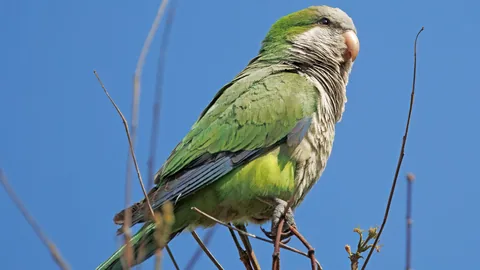
Monk Parakeet as a pet
Myiopsitta monachus
In short
This species may suit you if you can live with noise level ‘loud’, have room for an enclosure in class ‘medium’ and can care for the bird for up to about 40 years [S35, S49, S60, S67]. Biggest trade-off: the noise (class ‘loud’) [S67]. The perfect parrot doesn’t exist: a species profile is no guarantee about your bird.
This information was compiled with AI from public sources and may contain errors. Always check legal rules with the competent authority. Not buying, veterinary or legal advice.
Talking
‘Known for their ability to talk’ [S49]; pet birds develop ‘vocabularies of scores of words’ [S60].
Noise
WPT: ‘wide array of shrill screeches, squawks and chatter’ in flight and while feeding [S67].
Lifespan
About 25 years in captivity [S67]; VCA 20–30 years [S49]; Wikipedia 10–20 years [S60]. The sources differ.
Space
Flemish parakeet guideline per pair: small species 100 × 80 × 50 cm, larger species 150 × 150 × 80 cm [S35]; the page does not explicitly classify this species, so the larger class is used here to be safe. VCA: cage at least 60 × 60 × 90 cm (one bird) [S49].
Suitable for beginners?
No statement about beginners read. VCA (S49) and World Parrot Trust (S67) checked on 20/9/2026: neither gives an explicit statement about beginners.
Costs
From €240 per year per bird. Flemish Huisdierwijzer pet guide (parakeets S35 / lovebirds S36): about €20 per bird per month × 12. Price level unknown; not a full budget or quote.
Paperwork and rules in Belgium
EU Annex B (CITES II). Ask the seller for proof of legal origin (invoice, transfer declaration; EU model recommended) and keep it [S40]. According to the FPS, anyone who buys, sells or breeds these birds keeps a register of arrivals and departures and keeps it for at least 5 years [S39]. Status as of 27 September 2026; check the current rules for your bird with the Belgian FPS Public Health [S39]. Brussels-Capital Region: invasive species on Annex IV of the Brussels Nature Ordinance (Natuurordonnantie). Under Article 77 it is prohibited there to sell this species, transfer it free of charge or for payment, exchange or acquire it, or release it into the wild. That article does not prohibit keeping a bird you already have; federal rules on keeping animals still apply. In Flanders and Wallonia we found no ban on keeping or selling: the species is not on the EU list of invasive alien species (as of 2025), nor on a Flemish or Walloon list. Releasing a bird into the wild is, however, prohibited in both regions. Not legal advice. [S83, S84, S85, S105, S106, S107, S108]
Adoption and availability
Not seen on the rescue pages we read.
What you have to accept
- Noise class ‘loud’: only choose this species if your home situation can handle it [S67].
- Still unknown in the sources: suitability for beginners. That is not a ‘yes’.
- Talking is a possibility, not a promise: a species profile never predicts an individual bird [S49, S60].
- EU Annex B: ask the seller for proof of legal origin and keep it [S40].
Compare with
Rose-ringed Parakeet: less paperwork (no CITES annex versus EU Annex B) [S39, S40].
Rose-ringed Parakeet · Compare with Rose-ringed ParakeetGreen-cheeked Parakeet: quieter according to the sources (‘moderate’ versus ‘loud’), seen at a rescue [S4, S17, S67, S71].
Green-cheeked Parakeet · Compare with Green-cheeked ParakeetSun Parakeet: a similar profile on the known criteria, but louder (‘very loud’) [S54, S67].
Sun Parakeet · Compare with Sun Parakeet
Source basis
Veterinary information (VCA) + conservation organisation (WPT) + secondary source
Guideline sizes, costs and adoption listings come from Flemish sources; different rules may apply in Brussels and Wallonia. Foreign housing rules are not Belgian rules.
Sources
- S4 · LICG — Pyrrhura's · read 2026-09-06
- S17 · Wikipedia — Green-cheeked parakeet · read 2026-09-07
- S35 · Vlaanderen — Huisdierwijzer Parkieten · read 2026-09-19
- S36 · Vlaanderen — Huisdierwijzer Dwergpapegaai (Agapornis) · read 2026-09-19
- S39 · FOD Volksgezondheid — CITES-regels: Papegaaien · read 2026-09-24
- S40 · FOD Volksgezondheid — Beschermde soorten bezitten · read 2026-09-19
- S49 · VCA — Quaker or Monk Parakeets: General · read 2026-09-19
- S54 · Wikipedia — Sun parakeet · read 2026-09-19
- S60 · Wikipedia — Monk parakeet · read 2026-09-19
- S67 · World Parrot Trust — Parrot Encyclopedia: Monk Parakeet · read 2026-09-19
- S71 · adopteereendier.be — Volièrevogels · read 2026-09-19
- S83 · Leefmilieu Brussel — Europese en Brusselse regelgeving invasieve uitheemse soorten · read 2026-09-24
- S84 · Justel — Ordonnantie 1 maart 2012 betreffende het natuurbehoud (Brussels Hoofdstedelijk Gewest), art. 77 · read 2026-09-24
- S85 · Belgisch Staatsblad 17 april 2012 — Ordonnantie 1 maart 2012 betreffende het natuurbehoud (Brussels Hoofdstedelijk Gewest), Erratum: bijlagen, bijlage IV 'Invasieve soorten' (blz. 24076) · read 2026-09-27
- S105 · Uitvoeringsverordening (EU) 2016/1141 — Unielijst invasieve uitheemse soorten, geconsolideerde versie 7/8/2025 (M1 2017/1263, M2 2019/1262, M3 2022/1203, M4 2025/1422) · read 2026-09-28
- S106 · Natuur en Bos (Vlaamse overheid) — Exoten houden en kweken · read 2026-09-28
- S107 · Codex Vlaanderen — Soortenbesluit (BVR 15 mei 2009), art. 3 §1, 17, 31/2, 31/10 en 31/11 · read 2026-09-28
- S108 · WALLEX — Décret wallon du 2 mai 2019 relatif à la prévention et à la gestion de l'introduction et de la propagation des espèces exotiques envahissantes (+ AGW d'exécution du 15 septembre 2022) · read 2026-09-28
Sources checked as of:
Frequently asked questions
Which papers do you need for the Monk Parakeet in Belgium?
EU Annex B (CITES II). Ask the seller for proof of legal origin (invoice, transfer declaration; EU model recommended) and keep it. According to the FPS, anyone who buys, sells or breeds these birds keeps a register of arrivals and departures and keeps it for at least 5 years. Status as of 27 September 2026; check the current rules for your bird with the Belgian FPS Public Health. Brussels-Capital Region: invasive species on Annex IV of the Brussels Nature Ordinance (Natuurordonnantie). Under Article 77 it is prohibited there to sell this species, transfer it free of charge or for payment, exchange or acquire it, or release it into the wild. That article does not prohibit keeping a bird you already have; federal rules on keeping animals still apply. In Flanders and Wallonia we found no ban on keeping or selling: the species is not on the EU list of invasive alien species (as of 2025), nor on a Flemish or Walloon list. Releasing a bird into the wild is, however, prohibited in both regions. Not legal advice.
How long does the Monk Parakeet live?
About 25 years in captivity; VCA 20–30 years; Wikipedia 10–20 years. The sources differ.
How loud is the Monk Parakeet?
WPT: ‘wide array of shrill screeches, squawks and chatter’ in flight and while feeding.
Can the Monk Parakeet learn to talk?
‘Known for their ability to talk’; pet birds develop ‘vocabularies of scores of words’.
How much space does the Monk Parakeet need?
Flemish parakeet guideline per pair: small species 100 × 80 × 50 cm, larger species 150 × 150 × 80 cm; the page does not explicitly classify this species, so the larger class is used here to be safe. VCA: cage at least 60 × 60 × 90 cm (one bird).
What does the Monk Parakeet cost per year?
From €240 per year per bird. Flemish Huisdierwijzer pet guide (parakeets S35 / lovebirds S36): about €20 per bird per month × 12. Price level unknown; not a full budget or quote.