Air
Should I measure radon in my home?
Short answer
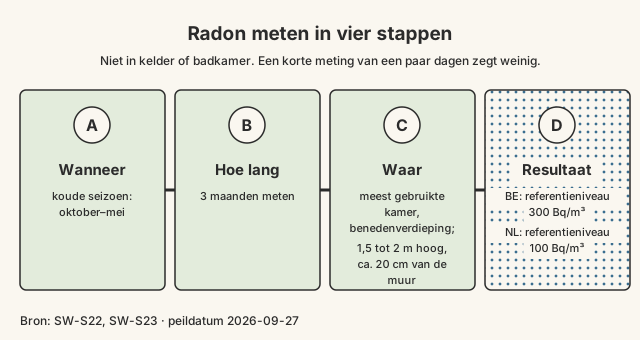
Measure if you live in an area with more radon. In Belgium the reference level for existing homes is 300 Bq/m³; in the Netherlands 100 Bq/m³.
Explanation
Radon is a natural radioactive gas from the soil. You cannot see or smell it. It enters through the floor and builds up in poorly ventilated rooms. Long-term exposure increases the risk of lung cancer, especially in smokers. Ventilation is the first measure.
Rules of thumb
- BE: measure for 3 months in the cold season (October–May), in the most used ground-floor room. [SW-S22]
- Place the detector at 1.5 to 2 m height and about 20 cm from the wall, not in a cellar or bathroom. [SW-S22]
- BE: a test costs € 15 via radonactie.be (FANC). [SW-S22]
- BE: remediate above 300 Bq/m³; target after remediation and for new builds 100 Bq/m³. [SW-S22]
Pitfalls
- A short measurement of a few days says little; radon fluctuates strongly. [SW-S22]
By region
- Belgium
- Reference level 300 Bq/m³; higher values mainly in parts of Wallonia (see the FANC map). [SW-S22]
- Netherlands
- Average 21 Bq/m³ (measurements 2022–2023); South Limburg average 59 Bq/m³; reference level 100 Bq/m³. [SW-S23]
Search terms
These search terms are in Dutch; only terms that also find a topic in English are links.
radon Bq/m³ longkanker FANC RIVM
Read also
General information, not personal advice. Check the source and reference date.
For health complaints: see your GP.
Sources
- SW-S22 Hoe kan u de radonconcentratie bij u thuis meten? — FANC (Federaal Agentschap voor Nucleaire Controle) (Reference date 2026-09-27)
- SW-S23 RIVM: radon in Nederlandse woningen en gebouwen nog altijd weinig — Autoriteit NVS (Reference date 2026-09-27)
Reference date: 2026-09-27 · Translated with AI from the Dutch original.