Growing golden oyster mushrooms
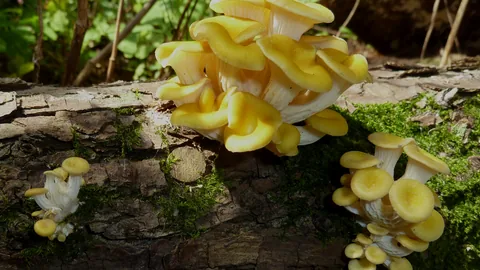
Golden oyster mushroom (Pleurotus citrinopileatus) is technically an easy kit species: the Belgian kit asks for 18 to 24 °C and a well-lit spot without direct sun. Do grow it indoors only, and do not put the spent block in the garden or on the compost heap.
Mushroom Mania (BE) · BS-25State of Michigan — Invasive Species Program · BS-79Royal Horticultural Society (VK) · BS-70In North America, golden oyster has escaped from cultivation and is considered invasive. For Belgium and the rest of Europe we found no reliable source on it growing wild.
State of Michigan — Invasive Species Program · BS-79Field & Forest Products (VS), blog sept. 2025 · BS-17Temperature and light
The Mushroom Mania kit gives 18–24 °C. Place it somewhere well lit without direct sun; Field & Forest gives 600 lux for this species.
Mushroom Mania (BE) · BS-25Field & Forest Products (VS) · BS-06Opening and keeping moist
Make a 3 cm slit in the plastic and spray the inside walls of the box 2 to 3 times a day, not the young mushrooms themselves.
Mushroom Mania (BE) · BS-25When to harvest?
Pins appear after about 2 weeks and the mushrooms follow a few days later. Harvest while the cap edges still curl slightly downwards. The kit gives up to 3 harvests.
Mushroom Mania (BE) · BS-25Why indoors only?
Field & Forest writes that golden oyster is now largely considered invasive in the US, that the strain escaped from indoor cultivation and that the producer has suspended sales of blocks. The State of Michigan advises keeping kits indoors, not composting them outdoors or even avoiding them. The RHS asks people not to simply compost spent kits of non-native species.
Field & Forest Products (VS), blog sept. 2025 · BS-17State of Michigan — Invasive Species Program · BS-79Royal Horticultural Society (VK) · BS-70What we do not know
The product page gives no yield and no fixed day for the first harvest. Whether golden oyster runs wild in Belgium is unknown.
Mushroom Mania (BE) · BS-25Growing and eating safely
An allergic lung reaction to inhaled spores has been described in professional oyster mushroom growers. No risk measure is known for a single hobby kit: harvest on time, do not grow in a bedroom and ventilate. Always eat the harvest cooked.
PubMed PMID 3169217 · BS-61PubMed PMID 10024747 · BS-62NCBI Bookshelf · BS-60GroCycle (VK) · BS-43Voedingscentrum · BO-02Source
- Kan je champignons/paddenstoelen rauw eten? — Voedingscentrum
- Growing Oyster Mushrooms on Straw — Field & Forest Products (VS)
- What we know about the invasive nature of golden oyster — Field & Forest Products (VS), blog sept. 2025
- Gele oesterzwam – Growkit — Mushroom Mania (BE)
- How to harvest mushrooms — GroCycle (VK)
- Hypersensitivity Pneumonitis (StatPearls, Chandra & Cherian, bijgewerkt 10-07-2023) — NCBI Bookshelf
- Extrinsic allergic alveolitis in oyster mushroom growers (Eur Respir J 1988) — PubMed PMID 3169217
- Hypersensitivity pneumonitis outbreak in oyster mushroom indoor cultivation (Occup Med 1998) — PubMed PMID 10024747
- How to grow mushrooms — Royal Horticultural Society (VK)
- Popular golden oyster mushrooms now invading Michigan forests (5 aug. 2025) — State of Michigan — Invasive Species Program
Checked on:
This is general growing information from the sources listed. Always follow the instructions of your kit or supplier. Only eat what demonstrably grows from your own culture of the bought, named species; if in doubt about colour, smell or shape, do not eat it.
This is not medical advice. If you repeatedly get a fever, a cough or shortness of breath while growing indoors, remove the culture and see your doctor.
Pick your species and your space; the tool shows what fits, with sources. No account needed.
Also good to know
Frequently asked questions
Growing golden oyster mushrooms: what should you know?
Golden oyster mushroom (Pleurotus citrinopileatus) is technically an easy kit species: the Belgian kit asks for 18 to 24 °C and a well-lit spot without direct sun. Do grow it indoors only, and do not put the spent block in the garden or on the compost heap.
When to harvest?
Pins appear after about 2 weeks and the mushrooms follow a few days later. Harvest while the cap edges still curl slightly downwards. The kit gives up to 3 harvests.
Why indoors only?
Field & Forest writes that golden oyster is now largely considered invasive in the US, that the strain escaped from indoor cultivation and that the producer has suspended sales of blocks. The State of Michigan advises keeping kits indoors, not composting them outdoors or even avoiding them. The RHS asks people not to simply compost spent kits of non-native species.
Golden oyster mushroom: can you grow it at home?
Only to a limited extent. The knowledge base lists this species as limited for growing at home. Growing it is simple (Belgian kit: ‘very easy’). ‘Limited’ is shown here for ecological reasons: in North America, golden oyster has escaped from cultivation and become invasive; the Michigan state government advises keeping kits indoors, not composting them outdoors, or even not using them at all, and an American producer suspended block sales. For Europe and Belgium we found no reliable source on escape into the wild: unknown. Project rule: grow indoors only, harvest in good time, tie spent blocks shut and put them in general waste, never in the garden or compost. Alternatives listed in the knowledge base: Oyster mushroom (grey oyster), Pink oyster mushroom.
Golden oyster mushroom: how difficult is it to grow?
Difficulty 1 on a scale of 1 to 5 (1 = kit on the table, 5 = lab or advanced).
Golden oyster mushroom: what temperature during fruiting?
Getting mushrooms to form (fruiting): 18–24 °C. Where sources differ, this is the widest range; follow the range given for your own product.
Golden oyster mushroom: which growing methods work?
According to the knowledge base, these methods work: Ready-to-fruit kit (level 1).