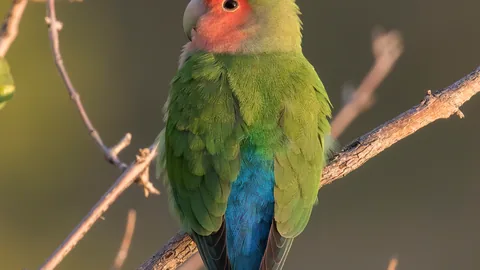
Rosy-faced Lovebird as a pet
Agapornis roseicollis
In short
This species may suit you if you can live with noise level ‘loud’, have room for an enclosure in class ‘small’ and can care for the bird for up to about 40 years [S3, S21, S36, S111]. Biggest trade-off: small is not quiet [S3, S36]. The perfect parrot doesn’t exist: a species profile is no guarantee about your bird.
This information was compiled with AI from public sources and may contain errors. Always check legal rules with the competent authority. Not buying, veterinary or legal advice.
Talking
Usually not a talker of human words. [S3, S10]
Noise
Lots of its own sounds; can make quite a racket [S3]; Flanders: ‘can chirp and screech very loudly’ (group; translated from Dutch) [S36].
Lifespan
Zoo-register record: 34.1 years; half of the birds that reached 4 years or more did not live beyond 6.7 years (data up to 2008) [S111]. Group indication 10–20 years [S3]; Flanders: 15 years on average [S36].
Space
Swiss law (for comparison; does not apply in Belgium) 0.24 m² per pair [S21]; Flanders at least 60 × 70 × 100 cm per pair [S36].
Suitable for beginners?
Flanders advises against hand-reared birds; no explicit verdict for beginners. Flemish Huisdierwijzer page on lovebirds (S36) rechecked on 20/9/2026: still no explicit statement about beginners found.
Costs
From €240 per year per bird. Flemish Huisdierwijzer pet guide (parakeets S35 / lovebirds S36): about €20 per bird per month × 12. Price level unknown; not a full budget or quote.
Paperwork and rules in Belgium
Not listed in the CITES/EU annexes. No CITES document required [S39]. Still keep proof of purchase; according to Flanders, a seamless closed leg ring is a good indication of legal origin [S35]. Status as of 27 September 2026; check the current rules for your bird with the Belgian FPS Public Health [S39].
Adoption and availability
Lovebirds at Nally’s and on adopteereendier.be [S70, S71]; which species was not checked.
What you have to accept
- Small is not quiet. Lots of its own sounds; can make quite a racket [S3]; Flanders: ‘can chirp and screech very loudly’ (group; translated from Dutch) [S36].
- Still unknown in the sources: suitability for beginners. That is not a ‘yes’.
Compare with
Budgerigar: quieter according to the sources (‘moderate’ versus ‘loud’), shorter commitment (‘up to about 20 years’) [S1, S3, S27, S36, S111].
Budgerigar · Compare with BudgerigarPacific Parrotlet: quieter according to the sources (‘moderate’ versus ‘loud’); but more paperwork (EU Annex B) [S3, S36, S39, S40, S55].
Pacific Parrotlet · Compare with Pacific ParrotletBourke's Parrot: quieter according to the sources (‘quiet’ versus ‘loud’), shorter commitment (‘up to about 20 years’); but more paperwork (EU Annex B) [S3, S21, S35, S36, S39, S40, S56, S111].
Bourke's Parrot · Compare with Bourke's Parrot
Source basis
Agapornis group knowledge
Guideline sizes, costs and adoption listings come from Flemish sources; different rules may apply in Brussels and Wallonia. Foreign housing rules are not Belgian rules.
Sources
- S1 · LICG — Grasparkiet · read 2026-09-06
- S3 · LICG — Dwergpapegaai · read 2026-09-06
- S10 · Lafeber — Lovebird · read 2026-09-06
- S21 · BLV — Papageien im Tierschutzrecht · read 2026-09-11
- S27 · Nicol & Pope (1993) — solitary vs group-housed budgerigars · read 2026-09-11
- S35 · Vlaanderen — Huisdierwijzer Parkieten · read 2026-09-19
- S36 · Vlaanderen — Huisdierwijzer Dwergpapegaai (Agapornis) · read 2026-09-19
- S39 · FOD Volksgezondheid — CITES-regels: Papegaaien · read 2026-09-24
- S40 · FOD Volksgezondheid — Beschermde soorten bezitten · read 2026-09-19
- S55 · Wikipedia — Pacific parrotlet · read 2026-09-19
- S56 · Wikipedia — Bourke's parrot · read 2026-09-19
- S70 · adopteereendier.be (Vlaamse overheid) — asielpagina Nally's Papegaaien Opvang · read 2026-09-19
- S71 · adopteereendier.be — Volièrevogels · read 2026-09-19
- S111 · Young, Hobson, Lackey & Wright (2012) — Survival on the ark: life-history trends in captive parrots, Animal Conservation 15: 28–43, tabel 2 · read 2026-10-20
Sources checked as of:
Frequently asked questions
Which papers do you need for the Rosy-faced Lovebird in Belgium?
Not listed in the CITES/EU annexes. No CITES document required. Still keep proof of purchase; according to Flanders, a seamless closed leg ring is a good indication of legal origin. Status as of 27 September 2026; check the current rules for your bird with the Belgian FPS Public Health.
How long does the Rosy-faced Lovebird live?
Zoo-register record: 34.1 years; half of the birds that reached 4 years or more did not live beyond 6.7 years (data up to 2008). Group indication 10–20 years; Flanders: 15 years on average.
How loud is the Rosy-faced Lovebird?
Lots of its own sounds; can make quite a racket; Flanders: ‘can chirp and screech very loudly’ (group; translated from Dutch).
Can the Rosy-faced Lovebird learn to talk?
Usually not a talker of human words.
How much space does the Rosy-faced Lovebird need?
Swiss law (for comparison; does not apply in Belgium) 0.24 m² per pair; Flanders at least 60 × 70 × 100 cm per pair.
What does the Rosy-faced Lovebird cost per year?
From €240 per year per bird. Flemish Huisdierwijzer pet guide (parakeets S35 / lovebirds S36): about €20 per bird per month × 12. Price level unknown; not a full budget or quote.