Growing button mushrooms (white and chestnut)
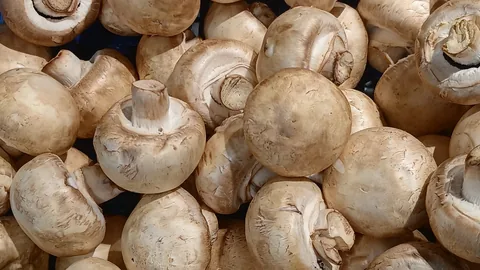
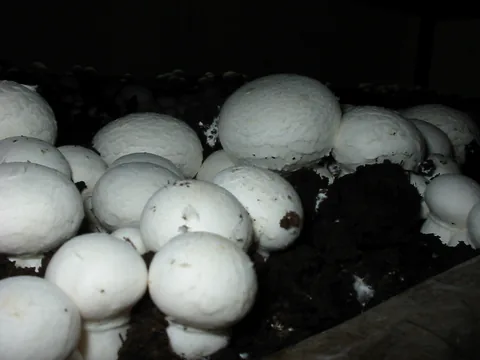
White button mushroom and chestnut mushroom are the same species, Agaricus bisporus. At home you grow them with a pack of colonised compost and a casing layer. For fruiting you need a cool spot of about 12 to 17 °C; the first harvest follows 15 to 21 days after casing.
Health and Safety Executive / Horticultural Development Company (VK) · BS-51Penn State Extension · BS-02Plukkers (NL/BE webshop) · BS-49Wageningen UR · BS-48Without a casing layer no mushrooms form. Making compost yourself is too difficult for a first project: Penn State calls the second compost phase possibly the most difficult step and watering the most delicate operation.
Wageningen UR · BS-48Penn State Extension · BS-02A cool spot
During fruiting, button mushrooms like it cool: Penn State gives 15–17 °C, a hobby web shop 12–15 °C. A cellar of about 20 °C is too warm for that; think of the cold season or a cooler room.
Penn State Extension · BS-02Plukkers (NL/BE webshop) · BS-49Colonisation
Let the compost colonise under cover. The hobby source first gives about 21 °C, commercial growing 24–25 °C for 14 to 21 days. With some packs the compost is already colonised; then follow your instructions.
Plukkers (NL/BE webshop) · BS-49Penn State Extension · BS-02Casing and moisture
Spread the casing in an even layer. Keep it moist but not wet: mist 1 to 2 times a day or cover it with damp cloths.
Penn State Extension · BS-02Plukkers (NL/BE webshop) · BS-49De Duurzame Tuin (NL) · BS-50Cooler and more air
When you see mycelium in the casing, move the pack somewhere cooler and ventilate so that CO₂ drops. Penn State gives 800 ppm or lower for pinning on one page and, on another, 1,000–2,500 ppm for pinning and cropping together, so follow your kit’s instructions.
Penn State Extension · BS-02Wageningen UR · BS-48Harvesting
In the fast growth phase a mushroom doubles every 24 hours: so check daily and cut them off with a knife. Flushes follow each other in a cycle of 7 to 10 days; Penn State mentions 3 to 4 flushes, of which the first 2 yield the most.
Penn State Extension · BS-02Plukkers (NL/BE webshop) · BS-49What we do not know
We found no independent yield figure for a hobby pack. A Dutch seller mentions up to 5 harvests, but its own instructions say 'with a bit of luck' 3.
De Duurzame Tuin (NL) · BS-50Growing and eating safely
The British Health and Safety Executive points to risks for the airways when growing and harvesting button mushrooms. No risk measure is known for a single hobby pack: do not grow in a bedroom and ventilate. Always eat button mushrooms cooked.
Health and Safety Executive / Horticultural Development Company (VK) · BS-51Voedingscentrum · BO-02Source
- Kan je champignons/paddenstoelen rauw eten? — Voedingscentrum
- Basic Procedures for Agaricus Mushroom Growing — Penn State Extension
- Literatuurstudie vocht in compost, dekaarde en champignons (Straatsma & Amsing 2005) — Wageningen UR
- Zelf champignons kweken in 5 eenvoudige stappen — Plukkers (NL/BE webshop)
- Kweekset champignon — De Duurzame Tuin (NL)
- Mushroom factsheet (HSE/HDC) — Health and Safety Executive / Horticultural Development Company (VK)
Checked on:
This is general growing information from the sources listed. Always follow the instructions of your kit or supplier. Only eat what demonstrably grows from your own culture of the bought, named species; if in doubt about colour, smell or shape, do not eat it.
Always cook mushrooms thoroughly. This is general public guidance, not personal nutrition or medical advice.
Pick your species and your space; the tool shows what fits, with sources. No account needed.
Also good to know
Frequently asked questions
Growing button mushrooms (white and chestnut): what should you know?
White button mushroom and chestnut mushroom are the same species, Agaricus bisporus. At home you grow them with a pack of colonised compost and a casing layer. For fruiting you need a cool spot of about 12 to 17 °C; the first harvest follows 15 to 21 days after casing.
What should you know about ‘A cool spot’?
During fruiting, button mushrooms like it cool: Penn State gives 15–17 °C, a hobby web shop 12–15 °C. A cellar of about 20 °C is too warm for that; think of the cold season or a cooler room.
What should you know about ‘Colonisation’?
Let the compost colonise under cover. The hobby source first gives about 21 °C, commercial growing 24–25 °C for 14 to 21 days. With some packs the compost is already colonised; then follow your instructions.
White button mushroom: can you grow it at home?
Yes. The knowledge base lists this species as one you can grow at home.
White button mushroom: how difficult is it to grow?
Difficulty 3 on a scale of 1 to 5 (1 = kit on the table, 5 = lab or advanced).
White button mushroom: what temperature during incubation?
Colonisation (incubation): 21–25 °C; duration 14–21 days. Where sources differ, this is the widest range; follow the range given for your own product.
White button mushroom: what temperature during fruiting?
Getting mushrooms to form (fruiting): 12–17 °C; duration 15–21 days. Where sources differ, this is the widest range; follow the range given for your own product.
White button mushroom: how long until the first harvest?
15–28 days according to the knowledge base; the time varies by method and product.
White button mushroom: which growing methods work?
According to the knowledge base, these methods work: Button mushrooms on compost with casing (level 3).
White button mushroom: when and how do you harvest?
In the fast growth phase a mushroom doubles in size every 24 hours: check daily. Cut off with a knife. Flushes follow each other in a cycle of 7–10 days; 3–4 flushes, the first two giving the most; one hobby supplier claims up to 5 harvests, each ±1 week after the previous one.