DISCOVER · WEIGH UP · UNDERSTAND
Which parrot is right for you?
The perfect parrot doesn’t exist. But you can discover what fits your life. Change a wish and see which trade-offs appear.
30 species profiles · sources as of September 2026 · not buying advice
This information was compiled with AI from public sources and may contain errors. Always check legal rules with the competent authority. Not buying, veterinary or legal advice.
What do your choices mean?
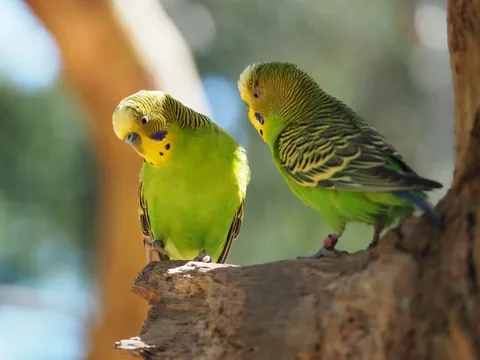
Budgerigar
Melopsittacus undulatus
Species card and sources
Constant contact chatter; sometimes quite loud. [S1] In Nicol & Pope (1993), budgerigars kept alone actually vocalised more. [S27]
Swiss law (for comparison; does not apply in Belgium): 0.24 m² floor for a pair of small birds [S21]; Flemish guideline for a small parakeet species per pair 100 × 80 × 50 cm (l × w × h) [S35].
Can reach 15–20 years; colour varieties often live shorter. [S1]
LICG, section ‘Experience needed’: “No special experience is needed to keep this pet responsibly.” (translated from Dutch) [S1] (checked 20/9/2026)
From €240 per year per bird. Flemish Huisdierwijzer pet guide (parakeets S35 / lovebirds S36): about €20 per bird per month × 12. Price level unknown; not a full budget or quote.
Not listed in the CITES/EU annexes. No CITES document required [S39]. Still keep proof of purchase; according to Flanders, a seamless closed leg ring is a good indication of legal origin [S35]. Status as of 27 September 2026; check the current rules for your bird with the Belgian FPS Public Health [S39].
Some learn words. [S1]
Offered on adopteereendier.be (aviary birds) [S71].
Species profile
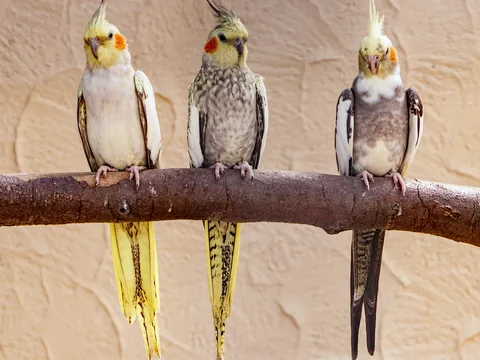
Cockatiel
Nymphicus hollandicus
Species card and sources
Relatively calm behaviour, but a shrill call. [S2] The only measured set of parameters in the file: distress call 502 ± 61 ms, fundamental frequency 2135 ± 114 Hz — not loudness. [S31]
Sources disagree: Swiss law (for comparison; does not apply in Belgium) 0.5 m² for a pair [S21]; Flemish parakeet page, small species 100 × 80 × 50 cm [S35]; the Flemish cockatoo page names cockatiels as an example of a small species with an aviary of at least 300 × 200 × 150 cm [S8]. Under the class rule (largest size mentioned) it is rated ‘large’.
Zoo-register record: 35.9 years; half of the birds that reached 4 years or more did not live beyond 7.1 years (data up to 2008) [S111]. About 15–20 years, sometimes older. [S2]
LICG, section ‘Experience needed’: “No special experience is needed to keep cockatiels responsibly.” (translated from Dutch) [S2] (already read on 6/9 but not recorded; literal sentence added on 20/9/2026)
From €240 per year per bird. Flemish Huisdierwijzer pet guide (parakeets S35 / lovebirds S36): about €20 per bird per month × 12. Price level unknown; not a full budget or quote.
Not listed in the CITES/EU annexes. No CITES document required [S39]. Still keep proof of purchase; according to Flanders, a seamless closed leg ring is a good indication of legal origin [S35]. Status as of 27 September 2026; check the current rules for your bird with the Belgian FPS Public Health [S39].
Mainly whistling; limited word imitation. [S2, S9]
Offered on adopteereendier.be [S71].
Species profile
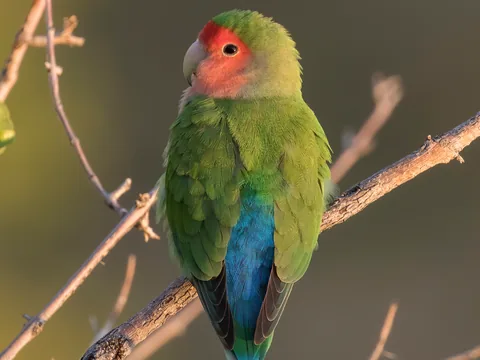
Rosy-faced Lovebird
Agapornis roseicollis
Species card and sources
Lots of its own sounds; can make quite a racket [S3]; Flanders: ‘can chirp and screech very loudly’ (group; translated from Dutch) [S36].
Swiss law (for comparison; does not apply in Belgium) 0.24 m² per pair [S21]; Flanders at least 60 × 70 × 100 cm per pair [S36].
Zoo-register record: 34.1 years; half of the birds that reached 4 years or more did not live beyond 6.7 years (data up to 2008) [S111]. Group indication 10–20 years [S3]; Flanders: 15 years on average [S36].
Flanders advises against hand-reared birds; no explicit verdict for beginners. Flemish Huisdierwijzer page on lovebirds (S36) rechecked on 20/9/2026: still no explicit statement about beginners found.
From €240 per year per bird. Flemish Huisdierwijzer pet guide (parakeets S35 / lovebirds S36): about €20 per bird per month × 12. Price level unknown; not a full budget or quote.
Not listed in the CITES/EU annexes. No CITES document required [S39]. Still keep proof of purchase; according to Flanders, a seamless closed leg ring is a good indication of legal origin [S35]. Status as of 27 September 2026; check the current rules for your bird with the Belgian FPS Public Health [S39].
Usually not a talker of human words. [S3, S10]
Lovebirds at Nally’s and on adopteereendier.be [S70, S71]; which species was not checked.
Agapornis group knowledge
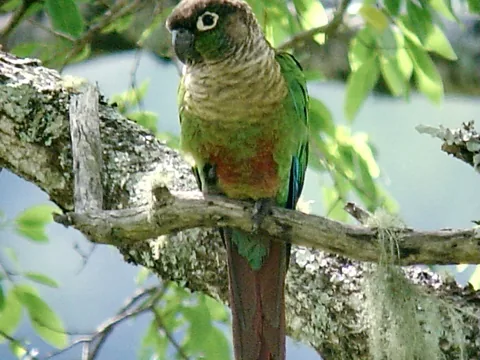
Green-cheeked Parakeet
Pyrrhura molinae
Species card and sources
Generally less noisy; excitement can lead to screaming [S4]; ‘the quietest of the conures’ (secondary) [S17].
No species minimum (S18). Flemish parakeet guideline for a larger species 150 × 150 × 80 cm per pair [S35], applied here conservatively: the page does not name the species.
With good care 25–30 years is possible; the average in captivity is closer to 10 years [S17].
LICG, on inexperienced keepers who are willing to study behaviour and needs thoroughly beforehand: “then P. frontalis and P. molinae are the most suitable.” The green-cheeked conure is P. molinae. This is conditional advice (only with thorough preparation), not a general recommendation for beginners. That is why ‘suitable for beginners’ is marked unknown here. [S4]
From €240 per year per bird. Flemish Huisdierwijzer pet guide (parakeets S35 / lovebirds S36): about €20 per bird per month × 12. Price level unknown; not a full budget or quote.
EU Annex B (CITES II). Ask the seller for proof of legal origin (invoice, transfer declaration; EU model recommended) and keep it [S40]. According to the FPS, anyone who buys, sells or breeds these birds keeps a register of arrivals and departures and keeps it for at least 5 years [S39]. Status as of 27 September 2026; check the current rules for your bird with the Belgian FPS Public Health [S39].
Sometimes a few words; usually not a strong talker. [S4]
‘Pyrrhura Pineapple’ (a colour mutation of P. molinae) on adopteereendier.be [S71].
Pyrrhura group knowledge
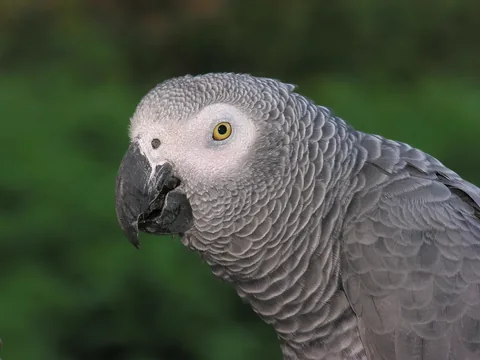
Grey Parrot
Psittacus erithacus
Species card and sources
Whistling and screaming; can be noisy at sunrise/sunset. [S5]
Flanders: a pair at least 200 × 200 × 200 cm; one bird at least 120 × 80 × 100 cm plus hours of free flight every day [S37]. Swiss law (for comparison; does not apply in Belgium) 0.7 m² per pair [S21].
Can reach about 60 years; many birds don’t. [S5, S37]
Flanders: ‘not a bird for beginners’ (translated from Dutch) [S37].
From €300 per year per bird. Huisdierwijzer, Flemish pet guide (grey parrot): €25–50 per month × 12 [S37]. Price level unknown; not a full budget or quote.
EU Annex A (CITES I). An original European CITES certificate (yellow A4) for each bird, with a matching ring number; check box 20 for restrictions [S39, S40]. Captive-born and captive-bred Annex A birds must also wear a closed, seamless leg ring with a unique mark, except species on the list of commonly bred species (that list was not checked here) [S77]. In exceptional cases (physical or behavioural traits of the bird) a microchip may replace the closed ring; if a vet removes a closed ring for medical reasons, the replacement chip number must be on the vet’s certificate [S77]. According to the FPS, anyone who buys, sells or breeds these birds keeps a register of arrivals and departures and keeps it for at least 5 years [S39]. Status as of 27 September 2026; check the current rules for your bird with the Belgian FPS Public Health [S39].
Great ability to mimic; speech is never guaranteed. [S5, S12]
Grey parrots at Nally’s [S70]. The rescue requires an enclosure of at least 800,000 cm³ for this species [S69].
Species profile; Timneh treated separately
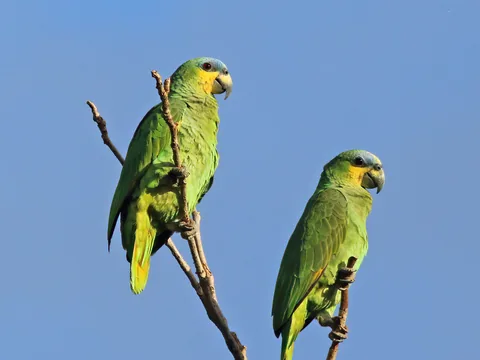
Orange-winged Amazon
Amazona amazonica
Species card and sources
Amazons can be loud, especially in the morning and evening (group). [S6]
LICG (Amazon parrot, group source): minimum aviary size for a pair 3 × 2 × 2 m (l×w×h) = 6 m² of floor space, with an indoor shelter of at least 1×1 m. If the birds get on well, an indoor aviary of at least 150×100×120 cm is possible. The class rule (largest pair size mentioned, ≥4 m² = large) gives ‘large’. No species-specific size found for A. amazonica; genus source (Amazona) applied. [S6] (checked 20/9/2026)
The group source mentions an exceptional 70–80 years; the average is much lower. [S6]
LICG (Amazon parrot, group source): “An Amazon parrot is not a bird for beginners.” (translated from Dutch) Experience with parrots is considered necessary; LICG advises taking a course on parrot behaviour beforehand. [S6] (checked 20/9/2026; page read earlier but this verdict not recorded)
From €276 per year per bird. LICG Amazon parrot (group source): pellet food from €0.75/day ≈ €23/month × 12 [S6]. Covers pellets only, not vegetables, fruit or the vet — so a lower limit, not a full annual cost. Vet and toys are not included. Price level unknown; not a full budget or quote.
EU Annex B (CITES II). Ask the seller for proof of legal origin (invoice, transfer declaration; EU model recommended) and keep it [S40]. According to the FPS, anyone who buys, sells or breeds these birds keeps a register of arrivals and departures and keeps it for at least 5 years [S39]. Status as of 27 September 2026; check the current rules for your bird with the Belgian FPS Public Health [S39].
Can imitate; less talkative than some other Amazons. [S6, S11]
Other Amazon species were seen at the rescue (yellow-crowned, double yellow-headed, yellow-cheeked), not this one [S70, S71].
Species + Amazona group knowledge
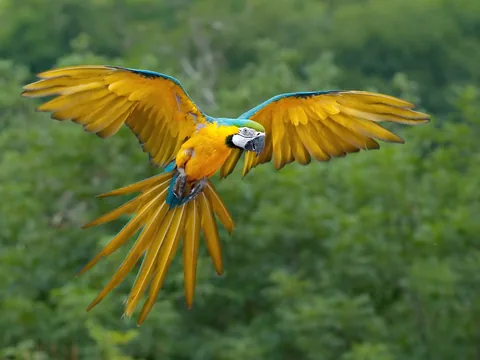
Blue-and-yellow Macaw
Ara ararauna
Species card and sources
Can scream very loudly; Flanders advises against a poorly soundproofed home [S7]; ‘amongst the most raucous’ (commercial) [S19].
Flanders: small macaw species at least 300 × 200 × 150 cm per pair, large macaws 400 × 300 × 200 cm, with a heated indoor shelter [S7]; Swiss law (for comparison; does not apply in Belgium) 10 m² / 30 m³ per pair [S21].
Macaws can live up to 80 years (group). [S7]
Flanders: only for experienced keepers; lots of fine dust [S7].
From €300 per year per bird. Huisdierwijzer, Flemish pet guide (macaws): €25–50 per month × 12 [S7]. Price level unknown; not a full budget or quote.
EU Annex B (CITES II). Ask the seller for proof of legal origin (invoice, transfer declaration; EU model recommended) and keep it [S40]. According to the FPS, anyone who buys, sells or breeds these birds keeps a register of arrivals and departures and keeps it for at least 5 years [S39]. Status as of 27 September 2026; check the current rules for your bird with the Belgian FPS Public Health [S39].
Both mimics and non-mimics in an owner survey. [S12]
Blue-and-yellow macaw at Nally’s [S70].
Species level for speech; macaw group for care
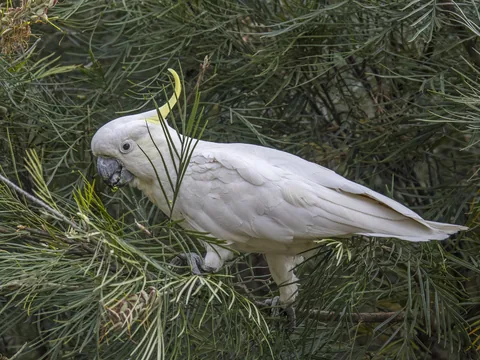
Sulphur-crested Cockatoo
Cacatua galerita
Species card and sources
Flanders: ‘one of the loudest parrots’ (group; translated from Dutch) [S8].
Flanders: larger cockatoo species (e.g. white cockatoo) at least 500 × 200 × 240 cm [S8]; Swiss law (for comparison; does not apply in Belgium) 10 m² / 30 m³ per pair [S21].
Some cockatoo species over 80 years (group) [S8].
Flanders: for advanced keepers [S8].
From €300 per year per bird. Huisdierwijzer, Flemish pet guide (cockatoos): about €25 per month × 12 [S8]. Price level unknown; not a full budget or quote.
EU Annex B (CITES II). Ask the seller for proof of legal origin (invoice, transfer declaration; EU model recommended) and keep it [S40]. According to the FPS, anyone who buys, sells or breeds these birds keeps a register of arrivals and departures and keeps it for at least 5 years [S39]. Status as of 27 September 2026; check the current rules for your bird with the Belgian FPS Public Health [S39].
Sometimes a few words. [S8]
Nally’s lists ‘sulphur-crested’ cockatoos; which species was not checked [S70].
Cockatoo group knowledge
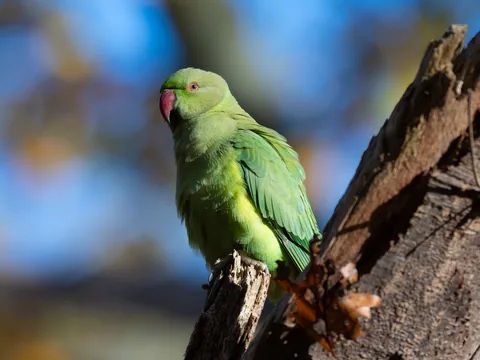
Rose-ringed Parakeet
Psittacula krameri
Species card and sources
‘A noisy species with an unmistakable squawking call’ [S59].
Flemish parakeet guideline per pair: small species 100 × 80 × 50 cm, larger species 150 × 150 × 80 cm [S35]; the page does not explicitly classify this species, so the larger class is used here to be safe. Length 37–43 cm [S59].
Not found at species level; Flemish parakeet group 10–30 years [S35].
No statement about beginners read. Wikipedia Rose-ringed parakeet (S59) rechecked on 20/9/2026: still no explicit statement about beginners; it does say ‘one of the best talking parrots’ and that hand-reared birds become tame, but gives no advice on experience.
From €240 per year per bird. Flemish Huisdierwijzer pet guide (parakeets S35 / lovebirds S36): about €20 per bird per month × 12. Price level unknown; not a full budget or quote.
Not listed in the CITES/EU annexes. No CITES document required [S39]. Still keep proof of purchase; according to Flanders, a seamless closed leg ring is a good indication of legal origin [S35]. Status as of 27 September 2026; check the current rules for your bird with the Belgian FPS Public Health [S39]. Brussels-Capital Region: invasive species on Annex IV of the Brussels Nature Ordinance (Natuurordonnantie). Under Article 77 it is prohibited there to sell this species, transfer it free of charge or for payment, exchange or acquire it, or release it into the wild. That article does not prohibit keeping a bird you already have; federal rules on keeping animals still apply. In Flanders and Wallonia we found no ban on keeping or selling: the species is not on the EU list of invasive alien species (as of 2025), nor on a Flemish or Walloon list. Releasing a bird into the wild is, however, prohibited in both regions. Not legal advice. [S45, S83, S84, S105, S106, S107, S108]
Both sexes can mimic speech; ‘one of the best talking parrots’ (secondary source) [S59].
Not seen on the rescue pages we read.
Species profile (secondary) + Flemish parakeet group
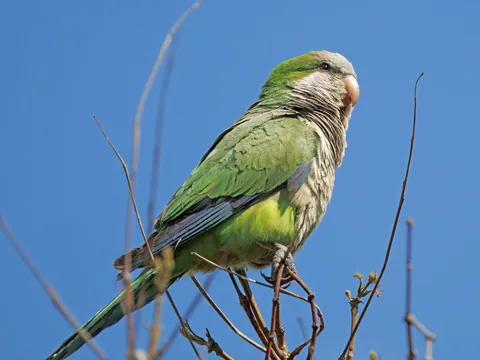
Monk Parakeet
Myiopsitta monachus
Species card and sources
WPT: ‘wide array of shrill screeches, squawks and chatter’ in flight and while feeding [S67].
Flemish parakeet guideline per pair: small species 100 × 80 × 50 cm, larger species 150 × 150 × 80 cm [S35]; the page does not explicitly classify this species, so the larger class is used here to be safe. VCA: cage at least 60 × 60 × 90 cm (one bird) [S49].
About 25 years in captivity [S67]; VCA 20–30 years [S49]; Wikipedia 10–20 years [S60]. The sources differ.
No statement about beginners read. VCA (S49) and World Parrot Trust (S67) checked on 20/9/2026: neither gives an explicit statement about beginners.
From €240 per year per bird. Flemish Huisdierwijzer pet guide (parakeets S35 / lovebirds S36): about €20 per bird per month × 12. Price level unknown; not a full budget or quote.
EU Annex B (CITES II). Ask the seller for proof of legal origin (invoice, transfer declaration; EU model recommended) and keep it [S40]. According to the FPS, anyone who buys, sells or breeds these birds keeps a register of arrivals and departures and keeps it for at least 5 years [S39]. Status as of 27 September 2026; check the current rules for your bird with the Belgian FPS Public Health [S39]. Brussels-Capital Region: invasive species on Annex IV of the Brussels Nature Ordinance (Natuurordonnantie). Under Article 77 it is prohibited there to sell this species, transfer it free of charge or for payment, exchange or acquire it, or release it into the wild. That article does not prohibit keeping a bird you already have; federal rules on keeping animals still apply. In Flanders and Wallonia we found no ban on keeping or selling: the species is not on the EU list of invasive alien species (as of 2025), nor on a Flemish or Walloon list. Releasing a bird into the wild is, however, prohibited in both regions. Not legal advice. [S83, S84, S85, S105, S106, S107, S108]
‘Known for their ability to talk’ [S49]; pet birds develop ‘vocabularies of scores of words’ [S60].
Not seen on the rescue pages we read.
Veterinary information (VCA) + conservation organisation (WPT) + secondary source
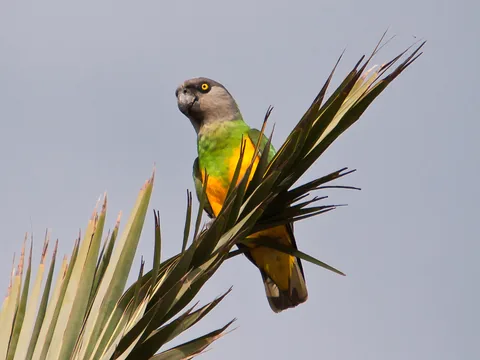
Senegal Parrot
Poicephalus senegalus
Species card and sources
SOURCES DISAGREE: VCA calls the voice ‘softer and quieter than other, larger parrots’ [S48]. WPT describes the species as ‘noisy with large variety of mainly harsh and high-pitched screeches, squawks and whistles’ [S66]. The filter uses the louder description.
VCA: cage for one bird at least 90 × 90 × 120 cm [S48]. WPT: walk-in aviary at least 2.1 m long [S66]. No floor area per pair, so the space class remains unknown.
VCA: 25–30 years, up to 50 years with good care [S48]. WPT: 20–25 years [S66].
Older or untamed birds can be ‘nippy’ [S48]. World Parrot Trust (S66) and VCA (S48) rechecked on 20/9/2026 for an explicit statement about beginners: none found.
No comparable source for annual costs found.
EU Annex B (CITES II). Ask the seller for proof of legal origin (invoice, transfer declaration; EU model recommended) and keep it [S40]. According to the FPS, anyone who buys, sells or breeds these birds keeps a register of arrivals and departures and keeps it for at least 5 years [S39]. Status as of 27 September 2026; check the current rules for your bird with the Belgian FPS Public Health [S39].
‘Readily learn human speech’ and mimic household sounds [S48].
Not seen on the rescue pages we read.
Veterinary information (VCA) + conservation organisation (WPT)
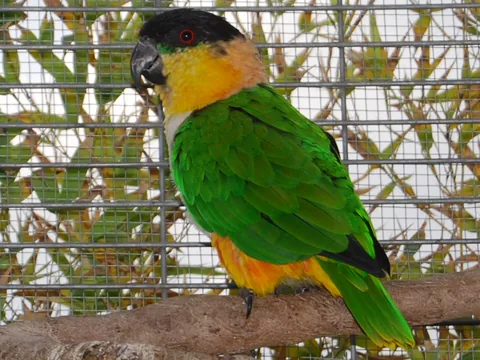
Black-headed Caique
Pionites melanocephalus
Species card and sources
WPT: ‘notably vocal and gregarious’ [S64]. That is about how often they call, not how loud; loudness remains unknown.
WPT: aviary or suspended cage at least 2 m long [S64]; secondary source: cage at least 61 × 61 × 91 cm [S52]. No area per pair, so space class unknown.
25–40 years in captivity according to World Parrot Trust [S64]; Wikipedia gives no figure [S52].
Tends to bite; teach boundaries early [S52]. World Parrot Trust (S64) checked on 20/9/2026 for an explicit statement about beginners: none found.
No comparable source for annual costs found.
EU Annex B (CITES II). Ask the seller for proof of legal origin (invoice, transfer declaration; EU model recommended) and keep it [S40]. According to the FPS, anyone who buys, sells or breeds these birds keeps a register of arrivals and departures and keeps it for at least 5 years [S39]. Status as of 27 September 2026; check the current rules for your bird with the Belgian FPS Public Health [S39].
Rarely mimics speech well; mostly everyday sounds (alarm clock, smoke detector, microwave) [S52].
Not seen on the rescue pages we read.
Conservation organisation (WPT) + secondary source
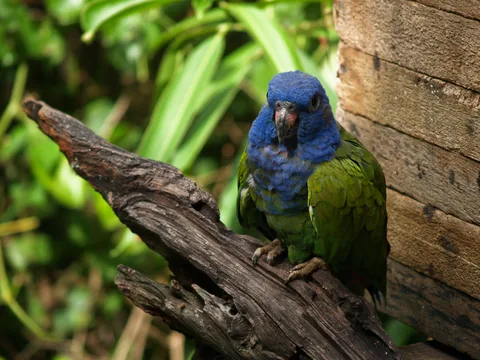
Blue-headed Pionus
Pionus menstruus
Species card and sources
LafeberVet: ‘relatively quiet, or least less noisy than larger parrots’, but loud calls especially early in the morning, late in the afternoon and in the breeding season [S63].
LafeberVet: minimum housing 50 × 60 × 100 cm; they love bathing [S63]. The source doesn’t say whether that applies to one bird or a pair, so the space class remains unknown.
Up to 25–40 years at most [S63].
No statement about beginners read. LafeberVet (S63) checked on 20/9/2026: no explicit statement for P. menstruus; there is one for another species on the same information sheet (‘may be the most aggressive Pionus spp., requiring a more experienced owner’, white-crowned pionus) — not adopted, because it is a different species.
No comparable source for annual costs found.
EU Annex B (CITES II). Ask the seller for proof of legal origin (invoice, transfer declaration; EU model recommended) and keep it [S40]. According to the FPS, anyone who buys, sells or breeds these birds keeps a register of arrivals and departures and keeps it for at least 5 years [S39]. Status as of 27 September 2026; check the current rules for your bird with the Belgian FPS Public Health [S39].
‘Not known for their talking ability’ [S53].
Not seen on the rescue pages we read.
Veterinary information (LafeberVet, specialist vet) + secondary source
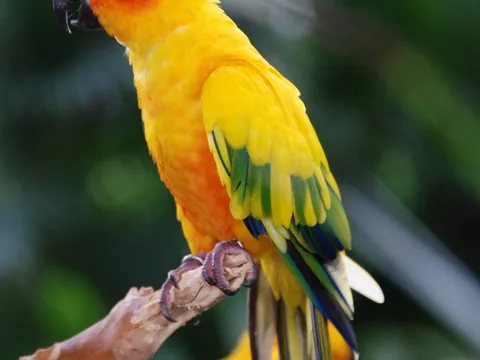
Sun Parakeet
Aratinga solstitialis
Species card and sources
Exceptionally loud for its size, with high-pitched screams [S54]. The source mentions ‘120 decibels’ without saying how this was measured, so we do not use that figure as a measurement.
Flemish parakeet guideline per pair: small species 100 × 80 × 50 cm, larger species 150 × 150 × 80 cm [S35]; the page does not explicitly classify this species, so the larger class is used here to be safe. Length about 30 cm [S54].
15–30 years in captivity [S54].
No statement about beginners read. Wikipedia Sun parakeet (S54) checked on 20/9/2026: no explicit statement about beginners; it does say ‘demands a great deal of attention’ and that constant mental stimulation is needed.
From €240 per year per bird. Flemish Huisdierwijzer pet guide (parakeets S35 / lovebirds S36): about €20 per bird per month × 12. Price level unknown; not a full budget or quote.
EU Annex B (CITES II). Ask the seller for proof of legal origin (invoice, transfer declaration; EU model recommended) and keep it [S40]. According to the FPS, anyone who buys, sells or breeds these birds keeps a register of arrivals and departures and keeps it for at least 5 years [S39]. Status as of 27 September 2026; check the current rules for your bird with the Belgian FPS Public Health [S39].
Moderate ability to mimic; not up to larger species [S54].
Not seen on the rescue pages we read.
Secondary source + Flemish parakeet group
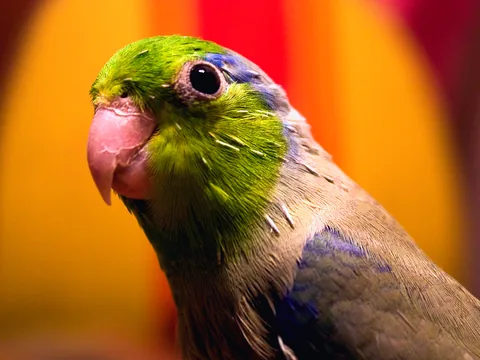
Pacific Parrotlet
Forpus coelestis
Species card and sources
High, fast ‘tchit’ call; constant chatter in a group [S55].
WPT: walk-in aviary at least 2.1 m long or indoor aviary at least 1.8 m [S65]. No width is given, so the space class remains unknown. Length 12.5 cm [S65].
Up to 25 years in captivity according to WPT [S65]; 10.4 years on average in the wild [S55].
Described as ‘feisty’ despite its small size [S55]. World Parrot Trust (S65) checked on 20/9/2026 for an explicit statement about beginners: none found.
No comparable source for annual costs found.
EU Annex B (CITES II). Ask the seller for proof of legal origin (invoice, transfer declaration; EU model recommended) and keep it [S40]. According to the FPS, anyone who buys, sells or breeds these birds keeps a register of arrivals and departures and keeps it for at least 5 years [S39]. Status as of 27 September 2026; check the current rules for your bird with the Belgian FPS Public Health [S39].
Can learn a few words, with limited clarity [S55].
Not seen on the rescue pages we read.
Conservation organisation (WPT) + secondary source
Bourke's Parrot
Neopsephotus bourkii
Species card and sources
Call described as a ‘soft twitter’ [S56] — relative, not a measurement.
Flemish parakeet guideline per pair: small species 100 × 80 × 50 cm, larger species 150 × 150 × 80 cm [S35]; the page does not explicitly classify this species, so the larger class is used here to be safe. Length about 19 cm [S56].
10–15 years in captivity, sometimes longer [S56].
‘Particularly popular among new bird owners’ (secondary source) [S56].
From €240 per year per bird. Flemish Huisdierwijzer pet guide (parakeets S35 / lovebirds S36): about €20 per bird per month × 12. Price level unknown; not a full budget or quote.
EU Annex B (CITES II). Ask the seller for proof of legal origin (invoice, transfer declaration; EU model recommended) and keep it [S40]. According to the FPS, anyone who buys, sells or breeds these birds keeps a register of arrivals and departures and keeps it for at least 5 years [S39]. Status as of 27 September 2026; check the current rules for your bird with the Belgian FPS Public Health [S39].
‘Rarely learn to talk’ [S56].
Not seen on the rescue pages we read.
Secondary source + Flemish parakeet group
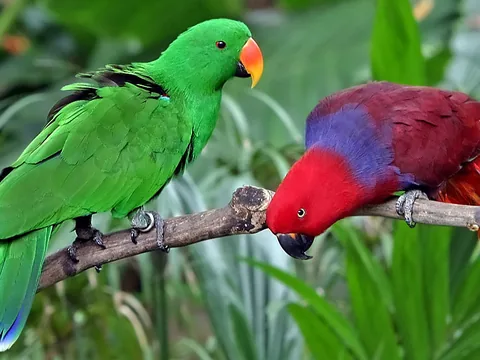
Eclectus Parrot
Eclectus roratus
Species card and sources
LafeberVet: ‘relatively quiet birds’ [S62]. This is relative, not a measurement.
LafeberVet: cage at least 61 × 91 × 122 cm (24 × 36 × 48 inches), ‘bigger is much better’ [S62]. It is not a size per pair, so the space class remains unknown.
30–40 years on average, 50–60 years at most [S62].
LafeberVet recommends experienced owners for females [S62]; the source doesn’t say this about males.
No comparable source for annual costs found.
EU Annex B (CITES II). Ask the seller for proof of legal origin (invoice, transfer declaration; EU model recommended) and keep it [S40]. According to the FPS, anyone who buys, sells or breeds these birds keeps a register of arrivals and departures and keeps it for at least 5 years [S39]. Status as of 27 September 2026; check the current rules for your bird with the Belgian FPS Public Health [S39].
Usually only talk clearly from about one year old [S51].
Not seen on the rescue pages we read.
Veterinary information (LafeberVet, specialist vet) + secondary sources
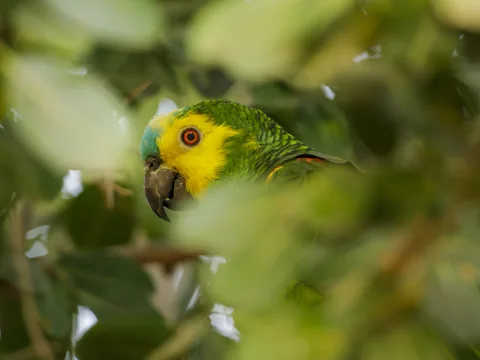
Turquoise-fronted Amazon
Amazona aestiva
Species card and sources
Amazons can be loud, especially in the morning and evening (group source) [S6].
WWF: plenty of room to fly and move; no size given [S46].
‘Up to 70 years in captivity’ [S46].
WWF: ‘extremely difficult to meet for its lifetime’ (high welfare risk) [S46].
From €276 per year per bird. LICG Amazon parrot (group source): pellet food from €0.75/day ≈ €23/month × 12 [S6]. Covers pellets only, not vegetables, fruit or the vet — so a lower limit, not a full annual cost. Vet and toys are not included. Price level unknown; not a full budget or quote.
EU Annex B (CITES II). Ask the seller for proof of legal origin (invoice, transfer declaration; EU model recommended) and keep it [S40]. According to the FPS, anyone who buys, sells or breeds these birds keeps a register of arrivals and departures and keeps it for at least 5 years [S39]. Status as of 27 September 2026; check the current rules for your bird with the Belgian FPS Public Health [S39].
Amazons can imitate (group source) [S6].
Not seen; the Amazons at the rescue are other species [S70].
WWF assessment + Amazona group knowledge
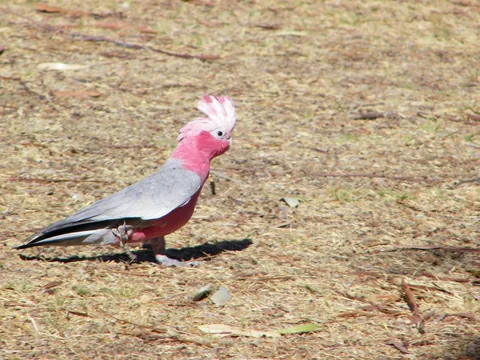
Galah
Eolophus roseicapilla
Species card and sources
Possibly unsuitable for an apartment, though ‘comparatively quieter than other cockatoo species’ [S57]; Flemish cockatoo group: ‘one of the loudest’ (translated from Dutch) [S8].
Flanders names the galah explicitly: a pair at least 300 × 200 × 150 cm [S8]; secondary source: aviary at least 7 m long [S57].
Up to 72 years recorded with strictly good nutrition [S57] (a record, not an expectation).
Flemish cockatoo group: for advanced keepers [S8].
From €300 per year per bird. Huisdierwijzer, Flemish pet guide (cockatoos): about €25 per month × 12 [S8]. Price level unknown; not a full budget or quote.
EU Annex B (CITES II). Ask the seller for proof of legal origin (invoice, transfer declaration; EU model recommended) and keep it [S40]. According to the FPS, anyone who buys, sells or breeds these birds keeps a register of arrivals and departures and keeps it for at least 5 years [S39]. Status as of 27 September 2026; check the current rules for your bird with the Belgian FPS Public Health [S39].
Can learn to talk and mimic sounds [S57].
Not seen on the rescue pages we read.
Secondary source + Flemish cockatoo group
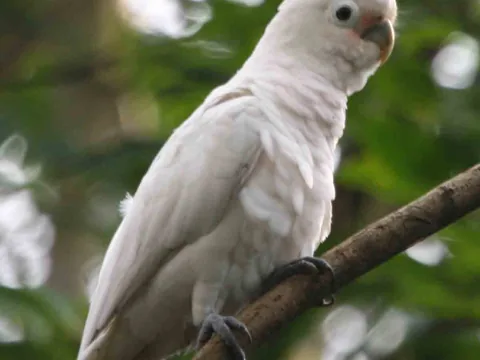
Goffin's Cockatoo
Cacatua goffiniana
Species card and sources
Quieter than large cockatoos, but with a sharp scream [S58].
All classes on the Flemish cockatoo page start at 300 × 200 × 150 cm per pair [S8]; Goffin’s cockatoo is not named there.
Up to 30 years in captivity [S58].
Flemish cockatoo group: for advanced keepers [S8]; secondary source: unsuitable for casual keeping [S58].
From €300 per year per bird. Huisdierwijzer, Flemish pet guide (cockatoos): about €25 per month × 12 [S8]. Price level unknown; not a full budget or quote.
EU Annex A (CITES I). An original European CITES certificate (yellow A4) for each bird, with a matching ring number; check box 20 for restrictions [S39, S40]. Captive-born and captive-bred Annex A birds must also wear a closed, seamless leg ring with a unique mark, except species on the list of commonly bred species (that list was not checked here) [S77]. In exceptional cases (physical or behavioural traits of the bird) a microchip may replace the closed ring; if a vet removes a closed ring for medical reasons, the replacement chip number must be on the vet’s certificate [S77]. According to the FPS, anyone who buys, sells or breeds these birds keeps a register of arrivals and departures and keeps it for at least 5 years [S39]. Status as of 27 September 2026; check the current rules for your bird with the Belgian FPS Public Health [S39].
Hand-reared birds can imitate speech but are usually poor talkers [S58].
Not seen on the rescue pages we read.
Secondary source + Flemish cockatoo group
Red-rumped Parrot
Psephotus haematonotus
Species card and sources
WPT describes shrill, whistling contact calls and ‘shrill chatter’ when squabbling [S88], but gives no view on how loud the species is. The class therefore stays unknown; not a measurement.
Flemish parakeet guideline per pair: small species 100 × 80 × 50 cm, larger species 150 × 150 × 80 cm [S35]; the page does not explicitly classify this species, so the larger class is used here to be safe. WPT: walk-in aviary at least 2.1 m long, or indoor aviary at least 1.8 m long [S88].
No species figure found (WPT gives no lifespan [S88]); Flemish parakeet group 10–30 years [S35].
No statement about beginners read. World Parrot Trust (S88) checked on 27/9/2026: no explicit statement about experience.
From €240 per year per bird. Flemish Huisdierwijzer pet guide (parakeets S35 / lovebirds S36): about €20 per bird per month × 12. Price level unknown; not a full budget or quote.
EU Annex B (CITES II). Ask the seller for proof of legal origin (invoice, transfer declaration; EU model recommended) and keep it [S40]. According to the FPS, anyone who buys, sells or breeds these birds keeps a register of arrivals and departures and keeps it for at least 5 years [S39]. Status as of 27 September 2026; check the current rules for your bird with the Belgian FPS Public Health [S39].
Unknown: the World Parrot Trust does not mention speech [S88] and no other species source was read.
Offered through Nally’s Papegaaienopvang on adopteereendier.be (a pair), read on 27/9/2026 [S70].
Conservation organisation (WPT) + Flemish parakeet group
Eastern Rosella
Platycercus eximius
Species card and sources
WPT mentions sharp flight calls, a shrill screech when startled and soft chattering while feeding [S89], but no view on loudness. Class therefore unknown; not a measurement.
Flemish parakeet guideline per pair: small species 100 × 80 × 50 cm, larger species 150 × 150 × 80 cm [S35]; the page does not explicitly classify this species, so the larger class is used here to be safe. WPT: walk-in aviary at least 3 m long, with bathing bowls [S89].
WPT: 20 years in captivity [S89]; Flemish parakeet group 10–30 years [S35]. The class follows the highest upper limit mentioned.
No statement about beginners read. World Parrot Trust (S89) checked on 27/9/2026: no explicit statement about experience.
From €240 per year per bird. Flemish Huisdierwijzer pet guide (parakeets S35 / lovebirds S36): about €20 per bird per month × 12. Price level unknown; not a full budget or quote.
EU Annex B (CITES II). Ask the seller for proof of legal origin (invoice, transfer declaration; EU model recommended) and keep it [S40]. According to the FPS, anyone who buys, sells or breeds these birds keeps a register of arrivals and departures and keeps it for at least 5 years [S39]. Status as of 27 September 2026; check the current rules for your bird with the Belgian FPS Public Health [S39].
Unknown: the World Parrot Trust does not mention speech [S89] and no other species source was read.
Not seen on the rescue pages we read.
Conservation organisation (WPT) + Flemish parakeet group
Alexandrine Parakeet
Psittacula eupatria
Species card and sources
WPT: ‘Harsh and loud in general’ [S90]; the call is deeper and harsher than that of the Rose-ringed Parakeet [S100]. Relative description, not a measurement.
Flemish parakeet guideline per pair: small species 100 × 80 × 50 cm, larger species 150 × 150 × 80 cm [S35]; the page does not explicitly classify this species, so the larger class is used here to be safe. WPT: metal aviary (wood gets chewed through), walk-in aviary at least 4.5 m long [S90]. That is only a length, not a floor area, so it is not counted in the class; it is, however, much larger than the Flemish guideline.
WPT: 25–30 years in captivity [S90]; secondary source: up to 40 years [S100].
No statement about beginners read. World Parrot Trust (S90) and Wikipedia (S100) checked on 27/9/2026: no explicit statement about experience.
From €240 per year per bird. Flemish Huisdierwijzer pet guide (parakeets S35 / lovebirds S36): about €20 per bird per month × 12. Price level unknown; not a full budget or quote.
EU Annex B (CITES II). Ask the seller for proof of legal origin (invoice, transfer declaration; EU model recommended) and keep it [S40]. According to the FPS, anyone who buys, sells or breeds these birds keeps a register of arrivals and departures and keeps it for at least 5 years [S39]. Status as of 27 September 2026; check the current rules for your bird with the Belgian FPS Public Health [S39]. Brussels-Capital Region: invasive species on Annex IV of the Brussels Nature Ordinance (Natuurordonnantie). Under Article 77 it is prohibited there to sell this species, transfer it free of charge or for payment, exchange or acquire it, or release it into the wild. That article does not prohibit keeping a bird you already have; federal rules on keeping animals still apply. In Flanders and Wallonia we found no ban on keeping or selling: the species is not on the EU list of invasive alien species (as of 2025), nor on a Flemish or Walloon list. Releasing a bird into the wild is, however, prohibited in both regions. Not legal advice. [S83, S84, S85, S105, S106, S107, S108]
‘Known to imitate human speech in captivity’ (secondary source) [S100].
Offered through Nally’s Papegaaienopvang on adopteereendier.be, read on 27/9/2026 [S70, S71].
Conservation organisation (WPT) + secondary source + Flemish parakeet group
Plum-headed Parakeet
Psittacula cyanocephala
Species card and sources
WPT: flight call ‘more musical than ring-necked’, males sing a song of rising and falling notes, also rapid shrill chattering [S91]. No view on loudness, so the class is unknown; not a measurement.
Flemish parakeet guideline per pair: small species 100 × 80 × 50 cm, larger species 150 × 150 × 80 cm [S35]; the page does not explicitly classify this species, so the larger class is used here to be safe. WPT: walk-in aviary at least 3 m long [S91].
WPT: 15–25 years in captivity [S91].
No statement about beginners read. World Parrot Trust (S91) checked on 27/9/2026: no explicit statement about experience.
From €240 per year per bird. Flemish Huisdierwijzer pet guide (parakeets S35 / lovebirds S36): about €20 per bird per month × 12. Price level unknown; not a full budget or quote.
EU Annex B (CITES II). Ask the seller for proof of legal origin (invoice, transfer declaration; EU model recommended) and keep it [S40]. According to the FPS, anyone who buys, sells or breeds these birds keeps a register of arrivals and departures and keeps it for at least 5 years [S39]. Status as of 27 September 2026; check the current rules for your bird with the Belgian FPS Public Health [S39].
Unknown: the World Parrot Trust does not mention speech [S91] and no other species source was read.
Not seen on the rescue pages we read.
Conservation organisation (WPT) + Flemish parakeet group
Lineolated Parakeet
Bolborhynchus lineola
Species card and sources
WPT: ‘soft, but far carrying’ calls [S92]; secondary source: ‘soft chatter and low noise levels’ [S101]. Relative, not a measurement.
Flemish parakeet guideline per pair: small species 100 × 80 × 50 cm, larger species 150 × 150 × 80 cm [S35]; the page does not explicitly classify this species, so the larger class is used here to be safe. WPT: indoor or outdoor aviary at least 1.2 m long; likes to climb [S92].
WPT: ‘15+’ years in captivity [S92]; secondary source: about 10 years on average, up to 15 [S101]; Flemish parakeet group 10–30 years [S35]. As WPT gives no upper limit, the class follows the group source.
No explicit statement about beginners read. Wikipedia (S101) mentions a ‘quiet and even-tempered disposition’, but that is not advice about experience; WPT (S92) checked on 27/9/2026: nothing about experience.
From €240 per year per bird. Flemish Huisdierwijzer pet guide (parakeets S35 / lovebirds S36): about €20 per bird per month × 12. Price level unknown; not a full budget or quote.
EU Annex B (CITES II). Ask the seller for proof of legal origin (invoice, transfer declaration; EU model recommended) and keep it [S40]. According to the FPS, anyone who buys, sells or breeds these birds keeps a register of arrivals and departures and keeps it for at least 5 years [S39]. Status as of 27 September 2026; check the current rules for your bird with the Belgian FPS Public Health [S39].
‘Talented mimics of human speech’ (secondary source) [S101].
Not seen on the rescue pages we read.
Conservation organisation (WPT) + secondary source + Flemish parakeet group
Turquoise Parrot
Neophema pulchella
Species card and sources
WPT: ‘soft, metallic notes’ in flight and ‘weaker, high-pitched twittering’ when feeding or resting [S93]. Relative, not a measurement.
Flemish parakeet guideline per pair: small species 100 × 80 × 50 cm, larger species 150 × 150 × 80 cm [S35]; the page does not explicitly classify this species, so the larger class is used here to be safe. WPT: walk-in aviary at least 2–2.5 m long [S93].
Zoo-register record: 26.5 years; half of the birds that reached 4 years or more did not live beyond 6.7 years (data up to 2008) [S111]. WPT: 10–15 years in captivity [S93].
No statement about beginners read. World Parrot Trust (S93) checked on 27/9/2026: no explicit statement about experience.
From €240 per year per bird. Flemish Huisdierwijzer pet guide (parakeets S35 / lovebirds S36): about €20 per bird per month × 12. Price level unknown; not a full budget or quote.
EU Annex B (CITES II). Ask the seller for proof of legal origin (invoice, transfer declaration; EU model recommended) and keep it [S40]. According to the FPS, anyone who buys, sells or breeds these birds keeps a register of arrivals and departures and keeps it for at least 5 years [S39]. Status as of 27 September 2026; check the current rules for your bird with the Belgian FPS Public Health [S39].
Unknown: the World Parrot Trust does not mention speech [S93] and no other species source was read.
Not seen on the rescue pages we read.
Conservation organisation (WPT) + Flemish parakeet group
Rainbow Lorikeet
Trichoglossus moluccanus
Species card and sources
WPT: repeated sharp, rolling calls in flight and shrill chattering while feeding [S94]. No view on loudness, so the class is unknown; not a measurement.
WPT: enclosure with a drain in the floor, or a suspended cage over a tiled or concrete floor [S94]. No size per pair, so the space class remains unknown.
WPT: 15–25 years in captivity [S94]; LafeberVet: 15–20 years on average for lorikeets [S99].
No statement about beginners read. LafeberVet (S99) calls the group ‘better suited as lively aviary birds’; that is not advice about experience. WPT (S94) checked on 27/9/2026: nothing about experience.
No comparable source for annual costs found.
EU Annex B (CITES II). Ask the seller for proof of legal origin (invoice, transfer declaration; EU model recommended) and keep it [S40]. According to the FPS, anyone who buys, sells or breeds these birds keeps a register of arrivals and departures and keeps it for at least 5 years [S39]. Status as of 27 September 2026; check the current rules for your bird with the Belgian FPS Public Health [S39].
LafeberVet (lories and lorikeets): ‘can learn words and tricks quite easily’ [S99].
Not seen on the rescue pages we read.
Veterinary information (LafeberVet, specialist vet, genus level) + conservation organisation (WPT)
Red-shouldered Macaw (Hahn’s Macaw)
Diopsittaca nobilis
Species card and sources
‘A noisy bird that is not suitable for apartment living’ (secondary source) [S102]; WPT: shrill, repetitive calls in short bursts [S95]. Relative, not a measurement.
WPT: birds kept in smaller cages should have access for part of the year to an enclosure at least 15 m long; keeping them permanently indoors is not recommended [S95]. No floor area per pair, so the space class remains unknown.
WPT: 25–40 years in captivity [S95]; secondary source the same [S102].
No statement about beginners read. WPT (S95) and Wikipedia (S102) checked on 27/9/2026: no explicit statement about experience.
No comparable source for annual costs found.
EU Annex B (CITES II). Ask the seller for proof of legal origin (invoice, transfer declaration; EU model recommended) and keep it [S40]. According to the FPS, anyone who buys, sells or breeds these birds keeps a register of arrivals and departures and keeps it for at least 5 years [S39]. Status as of 27 September 2026; check the current rules for your bird with the Belgian FPS Public Health [S39].
‘An excellent talker that can be taught many tricks’ (secondary source) [S102].
Not seen on the rescue pages we read.
Conservation organisation (WPT) + secondary source
Meyer’s Parrot
Poicephalus meyeri
Species card and sources
WPT: series of screeches with short pauses, duets in flight, a growling call that rises to a shriek when alarmed [S96]. No view on loudness, so the class is unknown; not a measurement.
WPT: walk-in aviary at least 2.1 m long, or indoor cage at least 1.8 m long [S96]. Lengths only, no floor area per pair, so the space class remains unknown.
WPT: 20–25 years in captivity [S96].
No statement about beginners read. World Parrot Trust (S96) checked on 27/9/2026: no explicit statement about experience.
No comparable source for annual costs found.
EU Annex B (CITES II). Ask the seller for proof of legal origin (invoice, transfer declaration; EU model recommended) and keep it [S40]. According to the FPS, anyone who buys, sells or breeds these birds keeps a register of arrivals and departures and keeps it for at least 5 years [S39]. Status as of 27 September 2026; check the current rules for your bird with the Belgian FPS Public Health [S39].
WPT: ‘Captive birds are mimickers’ [S96].
Not seen on the rescue pages we read.
Conservation organisation (WPT)
Red-crowned Parakeet (kākāriki)
Cyanoramphus novaezelandiae
Species card and sources
WPT: a long, repetitive series of notes in flight or when alarmed; subdued when feeding; three-syllable or soft, musical calls when perched [S97]. No view on loudness, so the class is unknown; not a measurement.
Flemish parakeet guideline per pair: small species 100 × 80 × 50 cm, larger species 150 × 150 × 80 cm [S35]; the page does not explicitly classify this species, so the larger class is used here to be safe. WPT: walk-in aviary at least 3 m long [S97].
WPT: ‘10+’ years in captivity, without an upper limit [S97]; Flemish parakeet group 10–30 years [S35]. The class follows the group source.
No statement about beginners read. Wikipedia (S103) calls the species ‘relatively easy to breed’; that is about breeding, not about experience as a keeper. WPT (S97) checked on 27/9/2026: nothing about experience.
From €240 per year per bird. Flemish Huisdierwijzer pet guide (parakeets S35 / lovebirds S36): about €20 per bird per month × 12. Price level unknown; not a full budget or quote.
EU Annex A (CITES I). An original European CITES certificate (yellow A4) for each bird, with a matching ring number; check box 20 for restrictions [S39, S40]. Captive-born and captive-bred Annex A birds must also wear a closed, seamless leg ring with a unique mark, except species on the list of commonly bred species (that list was not checked here) [S77]. In exceptional cases (physical or behavioural traits of the bird) a microchip may replace the closed ring; if a vet removes a closed ring for medical reasons, the replacement chip number must be on the vet’s certificate [S77]. According to the FPS, anyone who buys, sells or breeds these birds keeps a register of arrivals and departures and keeps it for at least 5 years [S39]. Status as of 27 September 2026; check the current rules for your bird with the Belgian FPS Public Health [S39].
Unknown: WPT (S97) and Wikipedia (S103) do not mention speech.
Not seen on the rescue pages we read.
Conservation organisation (WPT) + secondary source + Flemish parakeet group
Side by side
This applies to every parrot
Daily attention, space and things to do, suitable social housing, an avian vet and care during holidays all need preparation. A species profile never predicts an individual bird.
There are no comparable data on daily minutes of care. That’s why you won’t find a falsely precise filter for it.
Sources and limits
Guideline sizes, costs and adoption listings come from Flemish sources; different rules may apply in Brussels and Wallonia. Foreign housing rules are not Belgian rules.
S1 · LICG — Grasparkiet · read 2026-09-06
S2 · LICG — Valkparkiet · read 2026-09-06
S3 · LICG — Dwergpapegaai · read 2026-09-06
S4 · LICG — Pyrrhura's · read 2026-09-06
S5 · LICG — Grijze roodstaartpapegaai · read 2026-09-06
S6 · LICG — Amazonepapegaai · read 2026-09-06
S7 · Vlaanderen — Huisdierwijzer Ara's · read 2026-09-06; opnieuw 2026-09-19 (CITES, kosten, maten)
S8 · Vlaanderen — Huisdierwijzer Kaketoes · read 2026-09-06; opnieuw 2026-09-19 (maten, kosten, aantal)
S9 · VCA — Cockatiels: General Information · read 2026-09-06
S10 · Lafeber — Lovebird · read 2026-09-06
S11 · Tampa Bay Animal Hospitals — Amazon Parrots · read 2026-09-06
S12 · Benedict e.a. (2022) — vocal mimicry survey · read 2026-09-06
S17 · Wikipedia — Green-cheeked parakeet · read 2026-09-07
S18 · Windy City Parrot — minimum cage size green cheek · read 2026-09-07
S19 · Parrot Essentials — Blue and Gold Macaw care guide · read 2026-09-07
S21 · BLV — Papageien im Tierschutzrecht · read 2026-09-11
S27 · Nicol & Pope (1993) — solitary vs group-housed budgerigars · read 2026-09-11
S31 · Liévin-Bazin e.a. (2018) — distress calls in cockatiels · read 2026-09-11
S35 · Vlaanderen — Huisdierwijzer Parkieten · read 2026-09-19
S36 · Vlaanderen — Huisdierwijzer Dwergpapegaai (Agapornis) · read 2026-09-19
S37 · Vlaanderen — Huisdierwijzer Grijze roodstaartpapegaai · read 2026-09-19
S39 · FOD Volksgezondheid — CITES-regels: Papegaaien · read 2026-09-24
S40 · FOD Volksgezondheid — Beschermde soorten bezitten · read 2026-09-19
S45 · renature.brussels — Halsbandparkiet · read 2026-09-19
S46 · WWF — Blue-fronted Amazon (Responsible Pet Guide) · read 2026-09-19
S48 · VCA — Senegal Parrots: General · read 2026-09-19
S49 · VCA — Quaker or Monk Parakeets: General · read 2026-09-19
S51 · Wikipedia — Moluccan eclectus · read 2026-09-19
S52 · Wikipedia — Black-headed parrot · read 2026-09-19
S53 · Wikipedia — Blue-headed parrot · read 2026-09-19
S54 · Wikipedia — Sun parakeet · read 2026-09-19
S55 · Wikipedia — Pacific parrotlet · read 2026-09-19
S56 · Wikipedia — Bourke's parrot · read 2026-09-19
S57 · Wikipedia — Galah · read 2026-09-19
S58 · Wikipedia — Tanimbar corella · read 2026-09-19
S59 · Wikipedia — Rose-ringed parakeet · read 2026-09-19
S60 · Wikipedia — Monk parakeet · read 2026-09-19
S62 · LafeberVet — Basic Information Sheet: Eclectus Parrot (C. Pollock, DVM, DABVP Avian, 8 januari 2012) · read 2026-09-19
S63 · LafeberVet — Basic Information Sheet: Pionus (C. Pollock, DVM, DABVP Avian, 17 juli 2022) · read 2026-09-19
S64 · World Parrot Trust — Parrot Encyclopedia: Black-headed Parrot · read 2026-09-19
S65 · World Parrot Trust — Parrot Encyclopedia: Pacific Parrotlet · read 2026-09-19
S66 · World Parrot Trust — Parrot Encyclopedia: Senegal Parrot · read 2026-09-19
S67 · World Parrot Trust — Parrot Encyclopedia: Monk Parakeet · read 2026-09-19
S69 · Nally's Papegaaienopvang vzw (Oedelem) — Adopteer een papegaai · read 2026-09-19
S70 · adopteereendier.be (Vlaamse overheid) — asielpagina Nally's Papegaaien Opvang · read 2026-09-19
S71 · adopteereendier.be — Volièrevogels · read 2026-09-19
S77 · FOD Volksgezondheid — Identificatie en markering (CITES) · read 2026-09-21
S83 · Leefmilieu Brussel — Europese en Brusselse regelgeving invasieve uitheemse soorten · read 2026-09-24
S84 · Justel — Ordonnantie 1 maart 2012 betreffende het natuurbehoud (Brussels Hoofdstedelijk Gewest), art. 77 · read 2026-09-24
S85 · Belgisch Staatsblad 17 april 2012 — Ordonnantie 1 maart 2012 betreffende het natuurbehoud (Brussels Hoofdstedelijk Gewest), Erratum: bijlagen, bijlage IV 'Invasieve soorten' (blz. 24076) · read 2026-09-27
S88 · World Parrot Trust — Parrot Encyclopedia: Red-rumped Parrot · read 2026-09-27
S89 · World Parrot Trust — Parrot Encyclopedia: Eastern Rosella · read 2026-09-27
S90 · World Parrot Trust — Parrot Encyclopedia: Alexandrine Parakeet · read 2026-09-27
S91 · World Parrot Trust — Parrot Encyclopedia: Plum-headed Parakeet · read 2026-09-27
S92 · World Parrot Trust — Parrot Encyclopedia: Barred Parakeet · read 2026-09-27
S93 · World Parrot Trust — Parrot Encyclopedia: Turquoise Parrot · read 2026-09-27
S94 · World Parrot Trust — Parrot Encyclopedia: Rainbow Lorikeet · read 2026-09-27
S95 · World Parrot Trust — Parrot Encyclopedia: Red-shouldered Macaw · read 2026-09-27
S96 · World Parrot Trust — Parrot Encyclopedia: Meyer's Parrot · read 2026-09-27
S97 · World Parrot Trust — Parrot Encyclopedia: Red-fronted Parakeet · read 2026-09-27
S99 · LafeberVet — Basic Information Sheet: Lory and Lorikeet (C. Pollock, DVM, DABVP Avian, bijgewerkt 15 januari 2017) · read 2026-09-27
S100 · Wikipedia — Alexandrine parakeet · read 2026-09-27
S101 · Wikipedia — Barred parakeet · read 2026-09-27
S102 · Wikipedia — Red-shouldered macaw · read 2026-09-27
S103 · Wikipedia — Red-crowned parakeet · read 2026-09-27
S105 · Uitvoeringsverordening (EU) 2016/1141 — Unielijst invasieve uitheemse soorten, geconsolideerde versie 7/8/2025 (M1 2017/1263, M2 2019/1262, M3 2022/1203, M4 2025/1422) · read 2026-09-28
S106 · Natuur en Bos (Vlaamse overheid) — Exoten houden en kweken · read 2026-09-28
S107 · Codex Vlaanderen — Soortenbesluit (BVR 15 mei 2009), art. 3 §1, 17, 31/2, 31/10 en 31/11 · read 2026-09-28
S108 · WALLEX — Décret wallon du 2 mai 2019 relatif à la prévention et à la gestion de l'introduction et de la propagation des espèces exotiques envahissantes (+ AGW d'exécution du 15 septembre 2022) · read 2026-09-28
S111 · Young, Hobson, Lackey & Wright (2012) — Survival on the ark: life-history trends in captive parrots, Animal Conservation 15: 28–43, tabel 2 · read 2026-10-20
Frequently asked questions
How does the Parrot Compass help me choose?
You start with three wishes, for example about noise or space, and can then refine five more. You see which of the 30 species fit and what trade-offs appear. You can put up to three species side by side with 'Compare'.
Is this advice on buying a parrot?
No. The information was compiled with AI from public sources and may contain errors. It is not purchase, veterinary or legal advice. Always check legal rules with the competent authority.
Where does the data come from?
From 70 sources, such as LICG, the Flemish pet guide and the Belgian FPS Public Health. Every claim has a source number, and each source shows when we read it.
Do the rules apply to all of Belgium?
Guideline sizes, costs and adoption offers come from Flemish sources. Other rules may apply in Brussels and Wallonia. Foreign housing rules are shown for comparison only.
Do I need CITES papers?
It depends on the species. The species profile shows whether it is listed in a CITES or EU annex and which document goes with it. A budgerigar, for example, is not listed; a grey parrot (EU Annex A) needs an original EU certificate per bird. Check the current rules with the FPS Public Health.
What does a parrot cost over its lifetime?
The compass adds up the purchase price, the set-up and the yearly cost multiplied by the lifespan. The cost sources are Flemish and the price level is often unknown. Treat it as a rough order of magnitude, not a quote.
Are my choices saved?
Only if you choose to, and then in this browser. Nothing is stored in an account and nothing is sent automatically. You can also save your preferences as a file.
Image credits
All photos come from Wikimedia Commons under an open licence. They illustrate a species and are not evidence or an identification aid.
- Budgerigar · Photo: Sean Kelleher from Melbourne, Australia, CC BY-SA 2.0, via Wikimedia Commons · cropped · source
- Cockatiel · Photo: H. Zell, CC BY-SA 3.0, via Wikimedia Commons · cropped · source
- Rosy-faced Lovebird · Photo: Charles J. Sharp, CC BY-SA 4.0, via Wikimedia Commons · cropped · source
- Green-cheeked Parakeet · Photo: jeanpaulboerekamps, CC0, via Wikimedia Commons · cropped · source · Photo: hhulsberg, CC0, via Wikimedia Commons · cropped · source
- Grey Parrot · Photo: L.Miguel Bugallo Sánchez (http://commons.wikimedia.org/wiki/User:Lmbuga), CC BY-SA 3.0, via Wikimedia Commons · cropped · source
- Orange-winged Amazon · Photo: Charles J. Sharp, CC BY-SA 4.0, via Wikimedia Commons · cropped · source
- Blue-and-yellow Macaw · Photo: Luc Viatour, CC BY 2.0, via Wikimedia Commons · cropped · source
- Sulphur-crested Cockatoo · Photo: Charles J. Sharp, CC BY-SA 4.0, via Wikimedia Commons · cropped · source
- Rose-ringed Parakeet · Photo: Julian Herzog (Website), CC BY 4.0, via Wikimedia Commons · cropped · source
- Monk Parakeet · Photo: Charles J. Sharp, CC BY-SA 4.0, via Wikimedia Commons · cropped · source
- Senegal Parrot · Photo: Juan Emilio from Las Palmas de Gran Canaria, España, CC BY-SA 2.0, via Wikimedia Commons · cropped · source
- Black-headed Caique · Photo: Juan Caparrós, CC BY-SA 4.0, via Wikimedia Commons · cropped · source · Photo: Peter Békési, CC BY-SA 2.0, via Wikimedia Commons · cropped · source
- Blue-headed Pionus · Photo: Paul B from London, London, CC BY 2.0, via Wikimedia Commons · source
- Sun Parakeet · Photo: Michael Gwyther-Jones, CC BY 2.0, via Wikimedia Commons · cropped · source
- Pacific Parrotlet · Photo: Erin Purcell, CC BY 2.0, via Wikimedia Commons · cropped · source
- Bourke's Parrot · Photo: Christopher Watson (http://www.comebirdwatching.blogspot.com/), CC BY-SA 3.0, via Wikimedia Commons · cropped · source
- Eclectus Parrot · Photo: Doug Janson, CC BY-SA 3.0, via Wikimedia Commons · cropped · source · Photo: Don DeBold from San José, CA, USA, CC BY 2.0, via Wikimedia Commons · cropped · source
- Turquoise-fronted Amazon · Photo: Thomas Fuhrmann, CC BY-SA 4.0, via Wikimedia Commons · cropped · source
- Galah · Photo: Michael Spencer, CC BY 2.0, via Wikimedia Commons · source
- Goffin's Cockatoo · Photo: Lip Kee Yap, CC BY-SA 2.0, via Wikimedia Commons · cropped · source


Parrot Compass · Pausito
This information was compiled with AI from public sources and may contain errors. Always check legal rules with the competent authority. Not buying, veterinary or legal advice.